
Conductive electrical play with TENS and EMS units, the electrical opposite of violet wands — real current through tissue, so the violet-wand safety model does not carry over. Never cross the heart, the below-the-waist default, no pacemakers or heart conditions, never line current, electrode theory, burn prevention, and insertable-electrode hygiene. Builds on Violet Wands 101.
Deeper Cuts
E-Stim 101
A low hum, a tingle that builds, a muscle that twitches without being asked. Conductive e-stim is intimate, precise, genuinely electric — and it is the electrical opposite of the violet wand you just studied. The one belief this class is built to undo is that the skin-effect rules you learned next door will keep you safe here. They will not.
You arrive here from Violet Wands 101 holding a particular picture of electricity: high-frequency current that rides the outside of the body, a skin-effect discharge that mostly stays away from the places that could harm you — like the heart. That picture is true for a violet wand. It is dangerously false for a TENS or EMS unit. A conductive e-stim box does the reverse of a wand: it pushes real, low-frequency pulsed current through tissue, along the path of least resistance, driving nerve and muscle from the inside.
This is the conductive companion to the wand, not a sequel — and like the wand, it is edge play. You inherit that frame through the Violet Wands 101 and Edge Play: An Introduction chain, so we do not redefine it here. We simply hold you to it: real current through a person is a consequence that cannot be taken back.
The most dangerous belief a wand graduate can carry into this room is that conductive e-stim behaves like a violet wand. It does the opposite. A TENS unit sends real current through the body, not across its surface — you can see the proof in the muscle twitching it produces, because current that drives muscle is not staying on the skin. The skin-effect protection that lets a wand work near the chest does not exist here. If you have not done Violet Wands 101 and Edge Play: An Introduction, do them first — everything below assumes both, and assumes you will firewall the two safety models in your head.
What you’ll be able to do
By the end of this lesson, you’ll be able to…
- Explain how conductive e-stim differs from a violet wand — current through tissue vs. skin-effect on the surface — and why the difference changes every rule.
- State the hard contraindications and hold the firm never-cross-the-heart / below-the-waist default.
- Read monopolar vs. bi-polar electrodes, channels, and how a circuit actually completes.
- Run a start-low scene on external electrodes with off-before-insert / off-before-remove discipline.
- Recognize the stop signals — a stinging hotspot, non-negotiated pain, dizziness, or palpitations — and know to kill power first and end the scene.
- Clean and share-safely — and name the e-stim-specific failure modes: burns from intermittent contact, current detouring to the heart, and mains-fault electrocution.
In this lesson: the physics that makes every rule firm (§ I) · the hard contraindications and the never-cross-the-heart default (§ II–III) · never line current, and why (§ IV) · electrode theory, circuits, and the levers of sensation (§ V) · burns, the stop signals, operating discipline, and hygiene (§ VI–VII) · a negotiated scene, the myths, the mistakes, the pre-scene gut-check, and a glossary (§ VIII–XII). You learn why the current is unpredictable before you learn anything you could do with it.
And a word on what this class does not cover, so you know where to look. Violet Wands 101 / 201 own the Tesla-coil, skin-effect, glass-electrode modality — the surface play. Tease, Denial & Orgasm Control owns remote and app-driven vibrators, the Sybian, and fucking machines. Sensation Play 101 owns the Wartenburg wheel and the non-electrical sensation tools. Bondage 101 / 201 own restraint and quick-release. Edge Play: An Introduction owns the edge-play ethos this class inherits. Scene Emergencies & Response owns general crisis response — this class owns only the e-stim-specific electrical hazards.
I.The Physics Under Every Rule
Current takes the path of least resistance, not a straight line — and that path can change moment to moment.
The flow of current through a body is rarely a straight line, and rarely even a single line. Current follows the path of least resistance between the two electrodes, and that path can shift from one moment to the next as the body moves, as sweat and gel and contact change. You cannot predict the route. You cannot guarantee it. Two electrodes do not draw a tidy line between themselves — they open a region the current is free to wander.
This single fact is why every placement rule downstream is firm rather than optional. It is why keeping both electrodes below the waist minimizes risk rather than eliminating it: even with both pads low, a stray low-resistance route can side-trip upward, toward the chest, toward the heart. The rule is not arbitrary caution. It is the only honest answer to a path you cannot control — you keep the whole circuit far from the heart so that no plausible detour can reach it.
It is also the seed of the beginner-safe design you will meet in the electrode section. Because the path is unpredictable, the conductive-e-stim goal for a newcomer is to keep current local and short — to place the two poles so close together that there is no room for a side-trip. It is why bi-polar and tightly-paired electrodes are the default beginner choice.
II.Hard Contraindications
Some people are an absolute no. Screen for every one of them before an electrode touches skin.
Because the current really does travel through the body, some bodies are an absolute hard stop — not a “turn it down” case, not a negotiation. Lead with these the way you lead with the disqualifiers in any edge-play screen.
Pacemakers, ICDs, and any implanted electronics — full stop
An implanted electronic device is an absolute no-go, for two distinct reasons, and you should understand both:
- The heart runs on its own electricity. The heart is essentially powered by precisely controlled electrical impulses. External current can make it “jump” — the same effect that twitches a muscle on a lab bench — disrupting the rhythm it depends on. You never want to make a heart jump.
- The RF hazard. Many electrical toys emit a certain amount of radio signal, and a pacemaker is programmed by similar signals. A unit can therefore interfere with or even reprogram an implant.
The probability of any single incident may be small. The result is catastrophic and irreversible. That is what makes this common sense rather than a judgment call — you do not weigh a small chance against a fatal, permanent outcome. You simply do not play.
The rest of the absolute no list
- Serious heart conditions — arrhythmia, a prior heart attack — join implants as an absolute no.
- Pregnancy.
- Epilepsy or a seizure disorder.
The last two are carried over from the Violet Wands 101 screening — they are hard contraindications for electrical play of either kind. Screen for all of these in negotiation, before any electrode touches skin. For the full medical-history format — the yes/no health questions, the confidentiality framing, the way the hard no goes first — use the screening checklist in Violet Wands 101 rather than rebuilding it here.
Pacemakers, ICDs, insulin pumps, neurostimulators, any implanted electronics, and serious heart conditions are an absolute hard stop for conductive e-stim — the heart can be made to “jump,” and the RF a unit emits can reprogram an implant. Pregnancy and seizure disorders join them. Screen for all of it before an electrode touches skin, and if any are present, the answer is no scene, not a lower setting.
III.Never Cross the Heart
Both electrodes below the waist — a firm beginner rule, because the current really does travel through you.
Keep both electrodes of any circuit below the waist. No conductive e-stim above the belt. Because the current’s least-resistance path is unpredictable and can change moment to moment, you can never guarantee it will not cross the chest, the torso, or the heart — so you do not place electrodes where any plausible detour could reach them. The way you stop a stray route from reaching the heart is to keep the entire circuit far below it.
You may have heard below-the-waist-only dismissed as soft guidance — a sensible default you can bend once you know what you are doing. For a beginner it is not. It is a firm, non-optional rule, for exactly the reason the physics gives: the path is not a straight line, so you cannot be sure where the current goes. The reasoning that gets it waved off is the very reasoning that makes it binding.
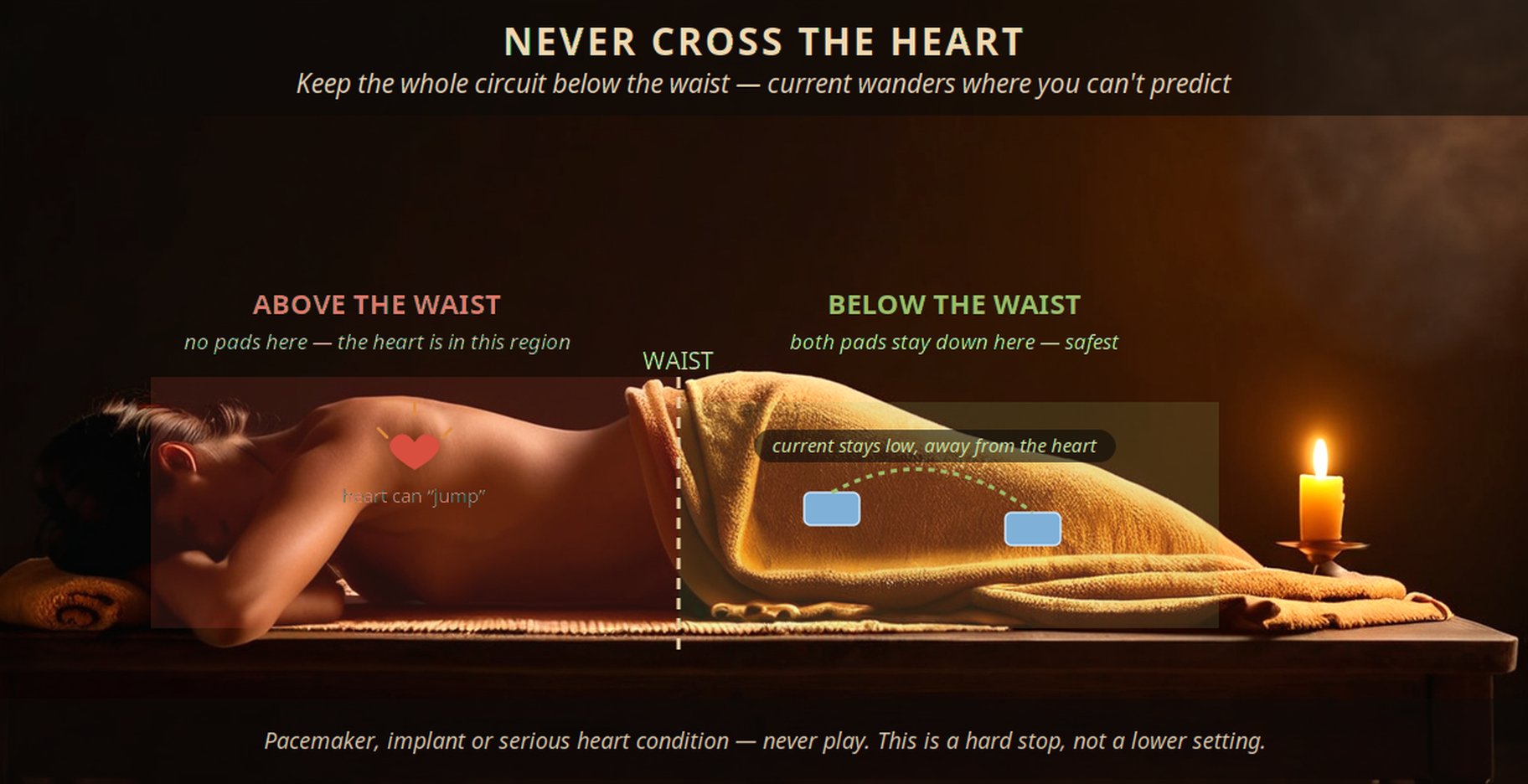
Keep both electrodes of every circuit below the waist. Nothing above the belt, nothing arranged so current could cross the chest or torso. This is firm, not a suggestion. Real current side-trips along routes you cannot predict, so the only safe move is to keep the whole circuit low.
Reconciling the two classes
You will remember from Violet Wands 101 that “never cross the heart” was framed there as a TENS rule, one a wand graduate did not have to fear in the same way, because skin effect keeps a wand’s high-frequency discharge on the surface. That reconciliation is correct — for the wand. Do not carry it here. For conductive e-stim, never-cross-the-heart and below-the-waist-only are binding, precisely because this current really does travel through tissue and really can side-trip toward the heart. The wand class earns its softer framing; this one does not.
IV.Never Line Current
Purpose-built battery or medical units only — a mains rig can become an expensive extension cord wired into a person.
Use only purpose-built, battery-powered or medical-grade units — a TENS unit, an EMS unit, a proper e-stim box. Household, wall, or line current must be shunned. Never improvise a mains-powered rig: no model-train transformers, no stereos, no plug-in gadget pressed into service as a power source.
Understand the failure mode, because it is what makes the rule absolute. An electrical device can fault in a way that delivers full line current to the output side — turning the transformer or gadget into, in effect, an expensive extension cord wired straight into a person. That is not a stronger tingle. That is lethal mains voltage where you expected a few harmless milliamps. A purpose-built battery box simply cannot do this; there is no mains on the input side to escape.
An honest note, so you are not misled by half-knowledge: devices called opto-isolators can reduce this risk, but implementing one correctly requires real electrical training. That is not an invitation to build your own — it is the reason a beginner buys a purpose-built box instead of building one. The violet wand is a separate modality entirely and is out of scope here; see Violet Wands 101 for why its glass electrode behaves differently.
Only purpose-built battery or medical-grade units — never a mains-powered improvisation. A plug-in device can fault and deliver full line current to the output, turning your gadget into a lethal extension cord run straight into a body. Opto-isolators can help but need real training, which is exactly why you buy a box rather than build one.
V.Electrodes & Completing the Circuit
Monopolar vs. bi-polar, channels, and the levers that shape every sensation.
A circuit needs two poles, a positive and a negative, with the body completing the loop between them. How those poles are arranged is the difference between current that stays local and current that wanders — which, after § I, you already know is the whole game.
Monopolar
Carries only one pole — positive or negative, not both. A sticky pad is the classic example. A monopolar electrode must be used in pairs to complete a circuit: current flows from one to the other. A monopolar dildo paired with a sticky pad, for instance, runs current dildo-to-pad.
Bi-polar
Carries both poles in a single toy — a butt plug with positive on one side and negative on the other, or positive near the tip and negative at the base. A self-contained bi-polar pad set on a single thigh works the same way. One toy, one self-contained circuit, both poles kept close together — and, like everything else here, placed below the waist.
The beginner-safe default, and why
A tightly-paired arrangement — the two poles placed close together — is the default beginner choice, and the reason is the physics of § I made practical. With the poles set close, the current flows directly between them and does not take side-trips toward the heart. Closely-spaced poles keep the current local. That is the whole design logic: short the path so there is no room to wander.
For a true first scene, keep it on the surface: a pair of external bi-polar pads — or two monopolar pads placed close together — on a fleshy spot below the waist, like a thigh or a cheek. External placement is the safest place to learn the two skills the rest of this class rests on: keeping contact continuous, and reading the ramp. A skin hotspot you can see and re-seat in a second; an internal one you cannot. Insertable electrodes — anal, vaginal — are the next step, not the session-one default. They stay fully in scope, and you will meet the discipline they demand in § VI and § VII — but you earn them after external contact and ramp are second nature, because an internal burn is harder to feel coming, harder to abort, and harder to treat than one on the skin.
A first scene belongs on external electrodes — bi-polar or tightly-paired pads on the skin, below the waist. You can watch the contact, see a problem, and re-seat instantly. Insertables stay in scope as the next step, once you have learned continuous contact and a controlled ramp on the surface — not on day one, when a hidden hotspot inside the body is the hardest burn to catch.
Current only flows within a channel between its own pair, never across to the other channel. Before you place anything, map which electrodes pair into which circuit — so you never accidentally arrange a pairing whose path would run across the torso.
Channels
A typical unit has two independent channels, each driving its own positive/negative pair with its own intensity. Current flows within a channel but not across channels. Run channel A on two pads — say, one on each ass cheek — and channel B on a second pair, and there is no current between the two pairs; they are two separate loops. This is powerful and it is a trap if you are careless: the channels keep paths separate only if you have mapped which electrode belongs to which pair, so that no pairing you set up could complete a circuit across the chest.
The levers that shape sensation
Just as the wand has contact area, electrode shape, and proximity, a TENS unit gives you three controls that set how a moment feels:
- Intensity — set per channel, so each pair can run at its own strength.
- Pulse width — how long each blip of current lasts, roughly 50–60 up to about 250 microseconds.
- Pulse rate — how many blips per second, roughly 2 up to about 150.
Unlike intensity, pulse width and pulse rate act on both channels at once. You cannot run one rate on one pair and a different rate on the other — whatever you set, both channels feel it. Plan your scene knowing the two pulse controls are shared.
The feel follows from the settings. A faster pulse rate reads as sharper, more “ouchie.” A slower rate gets a grab on the muscles — it can make them flex and dance. On top of the knobs, most units add a mode selector:
Normal
You drive the knobs directly. Predictable for both top and bottom — where a beginner lives.
Burst
Delivers clusters of quick pulses, a rest, then repeats the cycle — a rhythm rather than a steady stream.
Modulation
The intensity auto-varies every few seconds. Unpredictable on purpose — the bottom will not know what is coming next, and neither will you.
Many units also include a timer that cuts the current after a set number of minutes. We set it up here and apply it in the next section, where the timer becomes a way to bound exposure.
VI.Burns, Stop Signals & Operating Discipline
Intermittent contact is the injury. Continuous contact is the prevention. A sting is a stop, not a setting.
The signature e-stim injury is a burn, and the mechanism is precise: burns come from intermittent contact between an electrode and the skin — the contact breaking and remaking, concentrating current at the moment it reconnects. This is not theoretical. Experienced practitioners report a real and recurring crop of small burns from exactly this. The fix is equally precise: reliable, continuous skin contact.
That same mechanism is why this class teaches a stop signal as plainly as it teaches a safeword. A burn announces itself as a sharp, localized sting — and a sting that builds at one spot is the easiest signal in the world to talk yourself past, because you have been told all scene that the bottom owns the ramp. Do not. The ramp is for sensation you negotiated. A burning hotspot is not sensation; it is an injury starting, and the answer is to stop and re-seat, never to push through.
Stop the moment any of these appears, and the top kills power before anything else — the dial is the first thing your hand finds:
- A burning or stinging hotspot. Power off, lift the electrode, re-seat it with fresh gel or firm adhesion, then resume low. Never push through a sting — it is a stop, not a setting.
- Any non-negotiated pain, or sensation in a place you did not place an electrode — current may be detouring. Power off and reassess the whole circuit.
- Dizziness, lightheadedness, a racing or skipping heartbeat (palpitations), chest tightness, or any sign current is reaching the torso. These end the scene — power off, remove the electrodes, and seek medical care. This is not a re-seat; it is over.
None of these is a setting to dial back into. Power off, then decide — and when in doubt, the scene is over.
Conductive gel and pad adhesion
Any surface electrode that lacks its own tacky, self-adhesive surface needs conductive gel — for two reasons at once. First, full sensation: the gel delivers the current cleanly so the bottom feels what you intend. Second, burn prevention: the gel keeps the electrode in continuous contact despite whatever the bottom does, however they gyrate or tense. Self-adhesive pads supply their own contact — with those, your job is simply to make sure the adhesion stays firm and does not peel mid-scene, since a peeling pad is exactly how a hotspot starts.
The same intermittent-contact mechanism that burns the skin causes internal burns at the moment an internal electrode is partially in or breaking contact. Turn the unit fully off for that moment — both going in and coming out — so the circuit is dead while contact is incomplete. An internal hotspot is the one you cannot see, so the off-switch is your only guard at the riskiest moment.
Start low, and let the bottom lead
Bring each channel’s intensity up only on the bottom’s check-in feedback — the reported sensation leads, exactly as it does with a wand (see Violet Wands 101 for why the dial is never the authority). The bottom controls insertion depth and intensity tolerance, and says so out loud. The one thing the bottom does not get to override is a stop signal: a sting, a detour, dizziness, or palpitations end the ramp regardless of how much more they wanted. Use the unit’s timer where it has one to bound how long any circuit runs. And treat the Burst and Modulation modes as something you ramp into deliberately — named, agreed, eased toward — never something you spring on a bottom who is bracing for a steady, predictable sensation.
VII.Hygiene for Insertable Electrodes
Single-recipient, Hibiclens not bleach — and a condom does not make it shareable.
Once you have moved past external pads to insertable electrodes, hygiene becomes its own discipline. Internal electrodes are mostly stainless steel, and they are hard to clean thoroughly because of the way the electrical contacts attach to the body of the toy — the contacts hide where a swab cannot reach. For that reason, safer-sex educator Frank Strona of Scarlet Letter Services recommends against using insertable electrical gear on more than one recipient: treat internal stainless electrodes as single-recipient. They still need cleaning between sessions with the same person — spray with Hibiclens, let it sit ten minutes, then rinse thoroughly with plenty of warm water.
The contacts on internal — and especially bi-polar — electrodes are buried inside the toy and are likely made from materials less bleach-resistant than the exterior. A bleach dunk corrodes those contacts and degrades the toy. Use the Hibiclens soak, never a bleach solution, for internal stainless electrodes.
A condom is an insulator. On a conductive electrode it does two things at once: it blocks the current so the toy will not work as intended, and because it blocks current it is not a valid hygiene barrier either. You cannot substitute a condom for single-recipient practice and proper disinfection. This is the e-stim-specific exception to the usual “condom equals shareable barrier” assumption — here it equals neither working nor safe.
External toys with leather components
Some external toys — a penis harness, say — have leather parts that cannot simply be soaked. For those, wipe the toy, sponge it with a modern body-safe toy cleanser, rinse with clear water after a couple of minutes, and then apply a leather preservative. The principle that matters is the one to carry forward: leather cannot be soaked, so it is wiped and conditioned, not dunked.
Lube, by orifice
For insertable electrodes you want enough lube to seat the toy smoothly. The e-stim-specific point is the one to own here: silicone lube is fine on a bare stainless-steel electrode — the usual “silicone degrades a silicone toy” caution does not bite with steel. But if any part of the insertable is silicone or coated rather than bare steel, default to water-based so you do not degrade it, and pair lube to toy material as a standing habit. As for which lube suits which orifice — a thick water-based or hybrid for anal, water-based for vaginal, and a reminder that oil degrades any latex barrier in play — that is general lube-compatibility knowledge owned elsewhere; cross-reference it rather than re-teaching it here.
Urethral play is far more infection-prone than vaginal or anal play and demands hospital-level sterile technique with sterile surgical lube. This class names it only to gate it: it belongs behind real experience and direct mentorship, and you will find no how-to here. If you are drawn to it, that is a conversation with a mentor, not a paragraph in a beginner lesson.
VIII.A Negotiated Scene & Aftercare
Fully consented, external electrodes for a first scene, the bottom leading depth and intensity — the unpredictable modes named in advance, never sprung.
Before the scene, the bottom has consented to e-stim including the specific electrode locations, the intensity ramp, and any unpredictable modes. A safeword and a non-verbal stop signal are agreed in advance — and so is the shared understanding that a sting, a detour, dizziness, or palpitations stop the scene on their own, no safeword required. Throughout, the bottom directs depth and intensity — their reported sensation is the authority, not the top’s read of the dial — with the stop signals as the one limit that overrides “more.”
Make the unpredictable modes a negotiation item, not a surprise. Burst and Modulation auto-vary the sensation by design, which means they must be named and consented to up front. “The bottom will not know what is coming next” is a thrill only when the bottom has agreed to not knowing — never something you reveal mid-scene. They are also not where a first scene lives: a beginner stays in Normal mode, on external pads, with a steady, readable sensation.
External bi-polar or tightly-paired pads, both below the waist, keeping current local — insertables wait for a later scene. A purpose-built battery box, never mains. Conductive gel or firm pad contact, in Normal mode at a low setting. Start low, ramp only on check-ins, the bottom leading depth and intensity. A safeword and a non-verbal signal agreed, the stop signals understood by both, the dial within the top’s reach to kill instantly, the timer set to bound exposure, the unpredictable modes left for another day. Short, conservative, and screened. A first scene is a learning experience, not a test.
Where this sits in the chain
For the aftercare protocol — the warmth, the debrief, the watch for drop — cross-reference Aftercare 101. For the edge-play consent ethos that frames all of this, Edge Play: An Introduction, inherited through the Violet Wands 101 chain. General crisis response — what to do when a scene goes wrong in ways that are not specific to e-stim — belongs to Scene Emergencies & Response. This class owns only the three e-stim-specific hazards: burns from intermittent contact, current detouring to the heart, and mains-fault electrocution.
IX.Myths That Get People Hurt
Each of these has put someone in harm’s way. Learn to spot them on sight.
- “E-stim is basically the same as a violet wand.” It is the electrical opposite — the single most dangerous assumption a wand graduate can make. A wand rides the surface by skin effect; conductive e-stim drives real current through tissue and into muscle, and the wand’s safety model does not come with it.
- “No above the belt is just a suggestion.” For a beginner it is a firm rule. The current’s path is unpredictable and can side-trip toward the heart, so both electrodes stay below the waist. The casual attitude that treats it as bendable guidance is exactly what gets someone hurt.
- “The bottom owns the ramp, so a sting just means push past it.” No. A burning hotspot is an injury starting, not a setting. The bottom leads the negotiated sensation; a sting, a detour, dizziness, or palpitations stop the scene regardless of how much more anyone wanted. Power off and re-seat — or, for dizziness or palpitations, power off and seek care.
- “Insertable electrodes are just the normal way to play.” They are the next step, not the first one. A first scene belongs on external pads, where a hotspot is visible and re-seatable; an internal burn is the hardest to feel, abort, and treat. Earn insertables after contact and ramp are second nature.
- “A condom makes the toy safe to share.” A condom is an insulator — it blocks the current so the toy will not even work, and it is not a hygiene barrier. Internal electrodes are single-recipient and cleaned by Hibiclens soak.
- “Any battery toy is fine, so wiring up a mains gadget is fine too.” No. A purpose-built battery box cannot deliver mains current; a faulting plug-in device can put full line current into a person. Battery or medical-grade only, never an improvised mains rig.
- “Bleach is the strongest cleaner, so it must be best for the toys.” Bleach corrodes the buried internal contacts on stainless and bi-polar electrodes. Hibiclens soak, not bleach.
- “If it only tingles, there is no real risk.” The muscle twitching is proof the current is penetrating, not skimming. Heart contraindications, RF interference, and burns from intermittent contact are real even when the surface sensation feels mild.
X.Common Beginner Mistakes
The errors that actually cause the injuries.
- Carrying the wand’s skin-effect model over — treating chest proximity or surface-only assumptions as safe when the current is travelling through tissue.
- Arranging a circuit whose path could cross the torso — not mapping which electrodes pair into which channel before placing them.
- Starting on insertables — reaching for an anal or vaginal electrode in a first scene instead of learning contact and ramp on external pads, where a hotspot is visible and abortable.
- Letting contact go intermittent — skipping conductive gel or letting a pad peel, which concentrates current and burns.
- Pushing through a sting — reading a building hotspot as “more sensation to ramp into” instead of an injury to power off and re-seat.
- Ignoring whole-body warning signs — treating dizziness, a racing or skipping heartbeat, or sensation reaching the torso as something to play through, instead of killing power and seeking care.
- Inserting or removing an internal electrode with the unit live — the exact moment internal burns happen.
- Springing Burst or Modulation — revealing an unpredictable mode mid-scene instead of negotiating it in advance.
- Ramping intensity off the dial instead of off the bottom’s feedback — the reported sensation is the authority, not the knob — while never letting “more” override a stop signal.
- Sharing internal electrodes, or trusting a condom to make them shareable — single-recipient practice and Hibiclens cleaning, full stop.
- Improvising a power source — wiring e-stim to anything that plugs into the wall.
XI.Before You Plug In
A gut-check. Tap to tick — and notice anything you can’t honestly check off.
If you remember one thing: conductive e-stim sends real current through you — the violet-wand skin-effect rules do not protect you here. It is the electrical opposite of the wand: low-frequency pulsed current that follows the unpredictable path of least resistance, drives muscle, and can side-trip toward the heart. Keep it below the waist, off the mains, and local with bi-polar or tightly-paired placement — external pads for a first scene, insertables later. Screen the hard no’s, keep contact continuous, power off to insert or remove, clean internal electrodes by Hibiclens soak not bleach, and let the bottom lead — while a sting, a detour, dizziness, or palpitations stop the scene, power off first. Real current through a person is the consequence that cannot be taken back — that is why this is edge play.
XII.Quick Glossary
- Conductive e-stim
- Electrical play that drives real, low-frequency pulsed current through tissue along the path of least resistance — the opposite of a violet wand’s skin-effect surface discharge.
- TENS
- Transcutaneous electrical nerve stimulator — a unit that delivers pulsed current to interfere with pain receptors; the versions used for play add surface and insertable electrodes.
- EMS
- Electrical muscle stimulation — the muscle-driving cousin of a TENS unit; the muscle twitching is the visible sign current is penetrating, not skimming.
- Path of least resistance
- The route current actually takes between two electrodes — rarely a straight line, often more than one line, and able to change moment to moment, which is why placement rules are firm (see § I).
- Monopolar
- An electrode carrying only one pole, positive or negative; it must be used in a pair to complete a circuit, like a sticky pad paired with a monopolar dildo.
- Bi-polar
- An electrode carrying both poles in one toy, with the poles close together so current flows directly between them and stays local — external bi-polar pads are the beginner-safe starting point.
- Channel
- One independent positive/negative pair on the unit with its own intensity; current flows within a channel but never across to the other.
- Pulse width / pulse rate
- How long each blip of current lasts and how many blips per second; both are global controls acting on both channels at once.
- Mode (Normal / Burst / Modulation)
- The unit’s sensation patterns, taught in § V: a steady knob-driven setting, rhythmic pulse clusters, and an auto-varying setting that is unpredictable for top and bottom alike — a negotiated item, never a surprise; beginners stay in Normal.
- Intermittent contact
- Contact that breaks and remakes during play — the cause of e-stim burns, prevented by conductive gel, firm pads, and powering off to insert or remove internal electrodes.
- Stop signal
- A sensation that ends the action regardless of the negotiated ramp: a burning or stinging hotspot, any non-negotiated pain, dizziness, or palpitations. The top kills power first; a sting is re-seated, dizziness or palpitations end the scene and prompt seeking medical care.
- Hibiclens soak
- The cleaning method for internal stainless electrodes: spray, let it sit ten minutes, rinse with plenty of warm water — used instead of bleach, which corrodes the buried contacts.