
Open-flame play on the body, taught as the edge play it is — the one safe fuel (70 percent isopropyl) and its physics, fire wanding and fire cupping, and the safety spine: the Top watches the skin because a bottom rarely feels a true burn in time, a dedicated spotter, the fire blanket and wet towel that put out a person, the hair and face exclusion, never tying the bottom down, and burn care. Builds on Edge Play Intro.
Deeper Cuts
Fire Play 101
A line of pale flame drawn across the skin, riding a thin film of alcohol, gone before it leaves more than warmth and the smell of something burning very close. It is ritual, it is theatre, it is one of the most intimate things two people can do with an open flame — and it is edge play. The one belief this class exists to undo is that because it looks easy in a video, fire play is a safe trick. It is literal fire on a living body, and the bottom will often not feel a true burn until it is already too late, so the Top watches the skin and stops early.
A fire scene, stripped to its mechanics, is simple: a thin film of alcohol is wiped or wicked onto the surface of the skin, lit, and put out — fast, the flame riding a buffer of heated air just above the body. The light is low and blue-gold, the heat is brief, and a careful trail feels like warmth chasing a touch. It is beautiful, sensual, and theatrical. It is also edge play, and that is the single thing to carry out of this room.
This is a safety-literacy primer for informed consent and study, not a substitute for hands-on mentorship; it is not therapy. Fire play is taught body-to-body, with a mentor watching your hands, because the margin between a warm trail and a burn is narrow and most of it lives in habits you cannot learn from a page. If you have not done Edge Play: An Introduction, do it first — everything here assumes the frame it builds: that some activities carry consequences which cannot be taken back, and that the answer is study, honest consent, and managed risk rather than flinching away.
What you’ll be able to do
By the end of this lesson, you’ll be able to…
- Explain why fire play is edge play, and why the responsibility sits with the Top.
- State the 70%-isopropyl-only fuel rule and the physics of why the other 30% keeps a person safe.
- Run fuel discipline and stage a two-part safety kit before the first flame.
- Distinguish putting out a person (blanket and wet towel) from putting out a room (the dry-powder extinguisher).
- Screen health, negotiate a Fire Play Sampler, and run a conservative first scene.
- Recognise first- versus second-degree burns, and name the hard exclusions that live beyond a 101.
So the lesson moves the way a careful Top moves: it names the risk and where the responsibility sits before it lets you near a flame, settles the fuel and the physics before the tools, and front-loads the whole safety spine long before the technique progression and aftercare. The exclusions come last, on purpose, named so you know exactly where the line is.
In this lesson: the risks and why it’s edge play, and who carries the load (§ I–II) · the fuel, fuel discipline, and the physics that hurts people (§ III–V) · the tools, the two-part safety kit, and the technique progression (§ VI–VII) · the safety spine and the negotiation that gates it (§ VIII–IX) · psychology, the exclusions, aftercare, and a glossary (§ X–XIII).
I.The Risks — and Why It’s Edge Play
The worst case is severe and hard to take back, much of the danger is invisible to the bottom, and the consent bar is high. That is edge play.
Edge Play Intro defines edge play by risk, not intensity: activities where the potential for serious physical or psychological harm is higher, where the worst case can be severe or irreversible, and where safe practice depends on technical knowledge, honest consent, and careful risk management. Fire play meets every part of that definition, and it earns the name in the most literal way the curriculum offers — this is fire, on a body.
- Burns are an expected outcome, not a theoretical one. Assume a mild, sunburn-like first-degree mark is likely over a session. Second-degree blistering is a real injury. Deeper burns, or burns to the face, hands, feet, genitals, or over a joint, can mean the emergency room.
- Fire spreads. To hair, to bedding, to soft furnishings, to an unsecured fuel container, to the room. A scene that stays on the skin is the goal, not the guarantee — you build the room so that the fire has nowhere to travel.
- The danger is largely invisible to the person feeling it. Skin is a poor early-warning system for heat. By the time a true burn registers as pain, it has often already happened — which is the single fact that reshapes how this play is run.
- Some change is permanent. Burned hair may not grow back. Scarring is possible. These are not reversible, which is the whole point of the word “edge.”
- It reaches the mind. Open flame is powerful fear play; it can trigger panic or a trauma response in someone who never expected it to. The psychological edge is as real as the physical one.
The deadly myth is treating fire play as a safe, easy trick because it photographs beautifully — a thirty-second clip makes a trail of flame look like sleight of hand. It is not. Skill never removes the risk; it makes the risk understood, screened for, and managed with eyes open. This IS edge play, and it earns the name most around beginners, who meet the fire expecting a party trick and so never see the burn coming. Everything that follows is the patient case for why.
II.The Top Carries the Responsibility
In fire play the safeword cannot be the thing that prevents the burn.
Here is the thesis, stated once and fully, because the whole craft hangs on it. In most fire scenes the bottom will not feel a true burn until it has already happened — skin reads warmth long before it reads damage. That single fact inverts the usual safety logic: a fire Top cannot rely on the safeword to prevent injury, because by the time the bottom would think to call it, the harm is done. So the Top does not wait to be told. They watch the skin, read the heat, and stop early — sooner than they want to, sooner than the bottom would ever ask. Start slow. Leave them wanting more. The discipline of stopping before you feel ready is, more than anything else, the skill being taught.
Edge Play Intro frames this as PRICK — personal responsibility in informed consensual kink — and as the rule that whoever has the most to lose leads the caution. Fire play sharpens it into a specific inversion: the responsibility load sits squarely on the Top, not because the bottom matters less, but because the bottom’s own warning system is offline for the duration. The safeword still exists and is still honoured instantly; it simply is not the brake. The Top is.
For the length of a fire scene, you are the bottom’s nervous system. Their skin will not warn them in time, so you watch it for them and stop while there is still nothing to feel.
III.The Fuel — 70% Isopropyl, and Nothing Else
The fuel choice is a safety decision, made before the room is even set.
The most important safety decision in fire play is made before anyone touches a flame, and it is what you put in the cup. The answer is 70% isopropyl alcohol, only. The number is not a preference; it is the physics that keeps a person from being burned.
The other 30% is water, and that water does three things at once. It makes the fuel burn cooler and slower, so the heat reaching the skin is gentler and lingers less. It lets the fuel self-extinguish as the alcohol burns off and the water remains. And it leaves a thin buffer of heated air between the flame and the body, so the fire sits a short distance off the skin rather than directly on it. The beginner’s lever is less fuel, not weaker fuel — load the wand lightly and squeeze it nearly dry, so a thin film burns off in a heartbeat. Keep the fuel itself at 70%; do not try to mix your own ratio (especially never by watering down 91% or 99%).
Wintergreen-scented isopropyl is preferred for two safety reasons that have nothing to do with the smell being pleasant. The scent masks the unmistakable odor of singed hair, which keeps a scene from souring. And the green colour stops you confusing the fuel with water, or with a bottle of 91% or 99% that looks identical clear — a glance tells you which cup is which.
Never use 91% or 99% isopropyl. Never use accelerants — lighter fluid, white gas, and anything of that family. Higher-percentage alcohol and accelerants burn hotter, burn faster, and do not self-extinguish; they keep going after you expect them to stop. They are precisely how people get the burns this entire class is built to prevent. If the cup is not 70% isopropyl, the scene does not start.
If even 70% feels like more heat than you want to negotiate, that instinct is worth honouring: Wax Play 101 is the gentler temperature-on-skin cousin — different physics, lower risk, no open flame — and is a sound place to build temperature-play fluency first.
IV.Fuel Discipline
Most fire incidents are fuel-handling incidents, not flame-handling ones.
The flame on the skin is rarely what causes the bad night. The fuel is — how it is stored, poured, and carried to the body. Treat fuel handling as its own discipline, with its own hard rules:
- Use a marked metal or glass container — never the same kind of vessel you might confuse with water — kept on a separate surface, well away from the flame and from any open container.
- Pour out only a little fuel at a time. A small working cup limits how much can ever be alight at once.
- Never pour or refuel near an open flame. Cap the bottle, move away from the fire, and only then refill. Alcohol vapour travels, and a flame will find it.
- The wand must not drip. After loading the head, squeeze the excess out against the side of the cup before you ever bring it near the body. Coat the whole wand head so the fuel protects it, but let nothing run.
Excess alcohol runs off the head, follows gravity wherever gravity leads, and lights wherever it lands — on the bottom, on the bedding, on your own hand. A wand that drips has turned a contained flame into a moving one. Squeeze it dry against the cup every single time, before every pass.
V.The Physics That Hurts People
Learn how flame and fuel actually move on a body, and most of the danger becomes predictable.
Fire play stops being mysterious the moment you internalise two facts about how it moves. Plan the body position and the direction of your work around them, and the surprises mostly disappear.
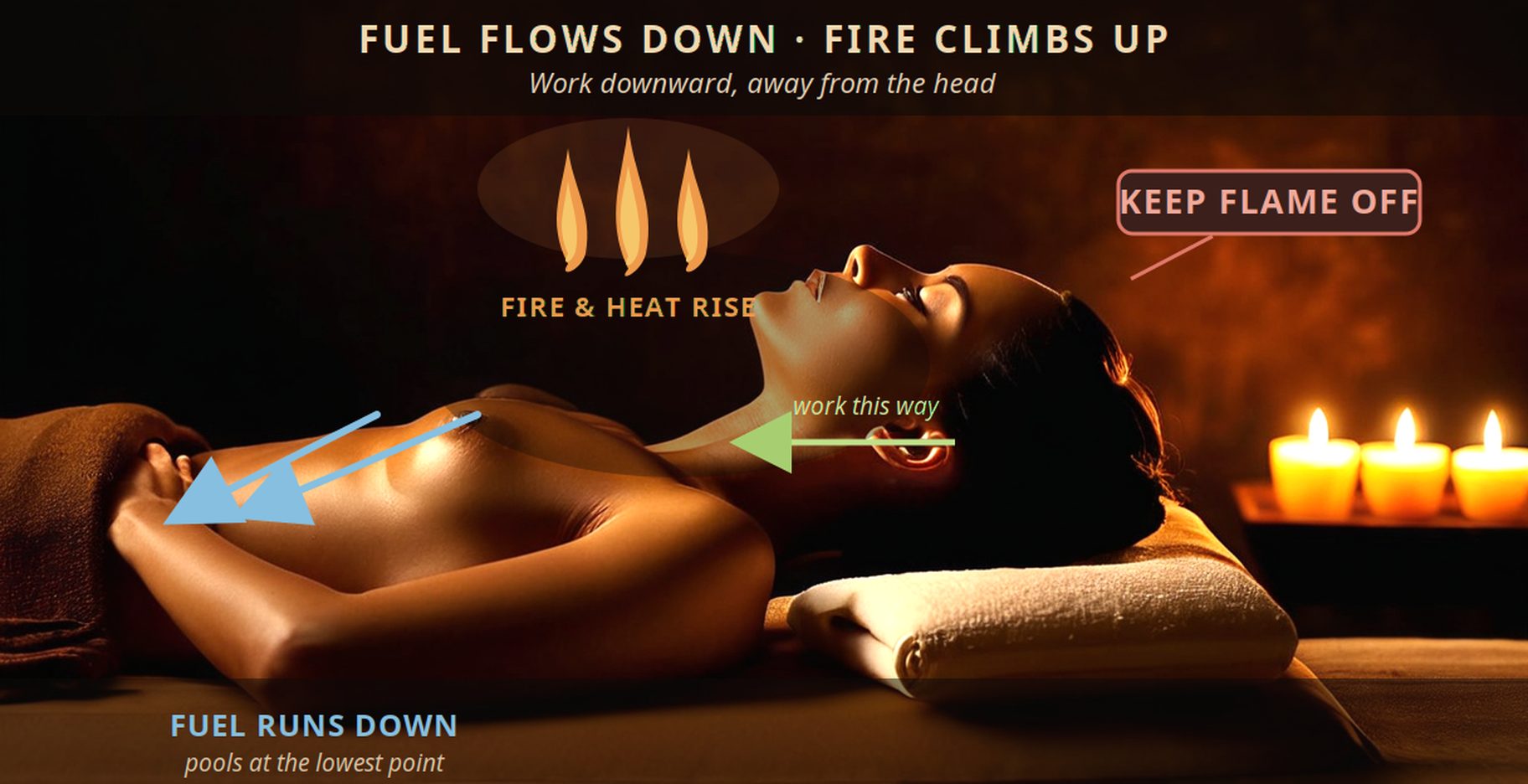
- Alcohol flows down; heat and fire travel up. Liquid fuel obeys gravity and runs toward the lowest point; flame and its heat climb the other way. So fuel pools below where you placed it, and any fire reaches up and over — toward the chest, the chin, the hair. Choose the body position and the direction of each pass with both of these in mind.
- Alcohol pools in crevices. Breasts, buttocks, the small of the back, any skin fold — fuel gathers there and, once lit, burns longer and hotter than on a flat plane. Treat every crevice as an extra-danger zone and either keep fuel out of it or work it last and lightest.
Two habits ride alongside the physics. Run a cool, damp cloth over the worked skin every few minutes — it clears residual alcohol so it cannot ignite where you did not intend, and the repeated cooling actually raises the bottom’s tolerance over a session. And re-read the room each time you move the body: a position that was safe lying flat changes the moment someone rolls.
Put the two facts together — fuel flows down, fire climbs up, and alcohol pools in the folds. That is the whole reason a trail can keep burning past where you laid it: the fuel ran somewhere you did not see, gathered in a crevice, and the flame followed it. In practice this means a concrete rule: orient the body and work so the flame never climbs toward the face, neck, or hair — work downward, away from the head — and never place or let fuel run into a crevice that sits below your active area, because it will pool there and the flame will follow it down. Plan position and pass-direction around this, clear residual fuel often, and you remove most of fire play’s nasty surprises before they happen.
VI.The Tools — and the Safety Kit
Two kits stage before the first flame: what makes the fire, and what ends it.
Nothing in fire play happens until both kits are laid out within reach. One kit makes the fire. The other ends it — and the second kit is not optional, not improvised, and not staged after the scene begins.
Tools of fire
- A fire wand — sometimes called a “dragon tongue” — is a Kevlar or cotton head on a rod or hemostat. It is the basic applicator of flame.
- Hemostats and cotton for building small wands and for fine, controlled work.
- Glass cups for fire cupping (§ VII).
- A sponge for the brief, broad warming work (the large-area “flash” versions of which are beyond a 101 — see § XI). Atomised or sprayed alcohol is never a 101 tool — a mist of fuel ignites as a cloud, not a film; spray techniques are cross-referenced out (§ XI).
- A fire-resistant surface — a leather pad, a fire blanket laid flat, a treated surface. Not the bed.
The safety kit — and a split you must never blur
The single most important thing to understand about the safety kit is that what you use on a person and what you use on a room are different tools, and confusing them causes harm.
| Tool | Use it on… | Never use it on… |
|---|---|---|
| ABC dry-powder fire extinguisher | The ROOM and objects — a curtain, the floor, furniture, a fuel spill alight. | A person. Never. The powder is harmful on skin and into airways. |
| Fire blanket + wet towels | A PERSON. These are what you smother a body with. | — |
| Room-temperature water | Cooling skin after the flame, and cooling a burn. | Never ice; never on an electrical fire. |
| First aid + burn care | Superficial redness and minor marks; staging for anything worse. | — |
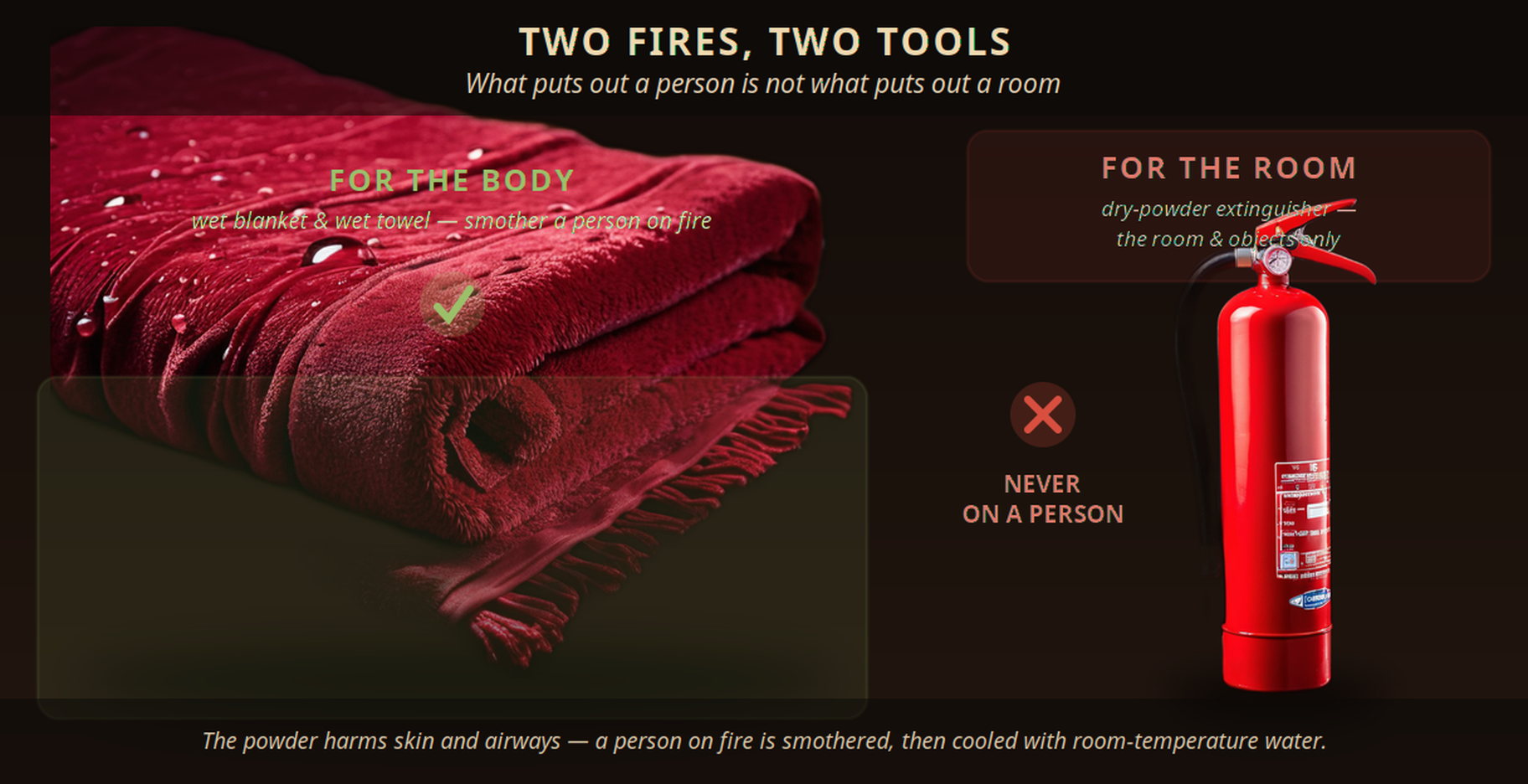
Say it until it is reflex: the dry-powder extinguisher is for the room and objects, never for a person. Its powder is harmful on skin and dangerous to inhale, and in the panic of a flare the wrong reach can make an injury worse. A person on fire is smothered with the fire blanket or a wet towel and then cooled with room-temperature water. This rule appears again in the safety spine because it is that important.
VII.Technique — the Progression
Build the skill in order, and never let the alcohol burn more than a couple of seconds.
The 101 progression is deliberately small. You are not learning to put on a show; you are learning to keep a flame contained, brief, and predictable. Work the stages in order, check in frequently, and never let a patch of alcohol burn for more than a couple of seconds before you put it out. A horizontal, laying body is both easier and safer than a standing one.
- Feel the heat. Before any flame touches skin, hold the lit wand several inches off the body and let the bottom feel only warmth. This calibrates them and you, with zero contact.
- Tap and follow-hand. Lightly tap the wand to the skin and immediately follow with your hand, pressing the flame out as your palm passes over it. Following with the hand does three jobs at once: it reassures the bottom, it raises their tolerance through contact, and it clears the residual fuel. Blowing or slapping a flame out is more sadistic in feel, but it is harder to be sure the fire is fully out — the follow-hand is the 101 default precisely because it confirms the out.
- Trail. Once the tap is clean and confident, lay a short trail of fire and follow the trail with your hand, putting it out as you go.
Fire wanding
One-wand basics are the tap and the short trail above. The two-wand “ribbon” is a step up: lay an alcohol ribbon on the skin with one wand held away from the body, then light it with a second, already-lit wand, with your free hand ready to put it out immediately. The unlit applicator never carries flame near the skin, and the lit wand never loads fuel — keeping those jobs separate is what keeps the ribbon controlled. This is the most advanced move in this 101, because a pre-laid ribbon of fuel burns along its whole length at once: keep the ribbon short, never let it outlive the couple-second window, follow it out with the hand from the moment it lights, and never lay a ribbon across or below a crevice where it can pool. Do it only after the tap and short trail are reflexive, and ideally with a mentor.
Fire cupping
Fire cupping combines heat and suction. A flame is briefly introduced into a glass cup to eat the oxygen inside; as the air cools and contracts it pulls a vacuum, and the cup suctions onto the skin, leaving a distinctive round bruise — so this is mark-making, and the mark must be negotiated. Work only fleshy, flat areas: buttocks, breasts, thighs, the back. Use thick, rounded-rim cups — test the rim against your own forearm first, because a sharp rim cuts. Sliding the cups around with a little oil or lube is an advanced add-on beyond this 101 — learn it hands-on with a mentor, not from this page. If you ever do use oil, treat it as a one-way gate: oil is fuel, so the moment any oil touches the skin the fire phase is over — no flame returns to that skin and no cup is re-lit for the rest of the scene. Glass is an insulator, so a cup lit “for show” usually transfers no real heat to the skin; the suction does the work. The non-negotiable: no alcohol may drip down the outside of the cup, or you have lit a fire where you did not mean to.
Fire massage and hands
Brief, broad, warming work with the flame and the follow-hand — the gentlest end of the spectrum, and a good place to spend most of a first scene. Broad does not mean more fuel: keep the film thin, keep each patch under the couple-second window, clear residual fuel with the cool cloth between passes, and stay off crevices. Broad-area work magnifies every fuel mistake, which is why the large-area “flash” versions are out of scope (§ XI).
The cupping bruise is a deliberate mark: negotiate it the way you would any mark. It also raises the bleeding-and-clotting screen in § VIII — bruising matters more for someone on blood-thinners. And if a cup ever cracks or breaks skin, that crosses into blood exposure: stop, and bring the principles of Bloodborne & Aseptic to bear.
VIII.The Safety Spine
The non-negotiables. Stage them before the first flame, and treat each as a hard rule.
These are the load-bearing rules of fire play. They are not tips. Each one is staged and confirmed before the first flame, and each is a hard line.
Fire play is never a solo-Top activity. A dedicated spotter — a fire warden — keeps eyes on the far side of the body, provides an extra set of hands, holds the wet cloth ready, and can call the stop independently. All safety gear is staged within the warden’s reach before the first flame, not fetched mid-scene.
Smother a person with the fire blanket or a wet towel and cool with room-temperature water. Not the dry-powder extinguisher — that is for the room and objects only and is harmful on skin. Not ice. There is only a couple-second window before a trail stops being a quick out and starts to truly burn, so the warden moves the instant a flame outlives its purpose.
Both people’s head hair is tied back and covered and beards secured — the bottom’s most of all, as theirs is closest to the flame. Burning hair ignites instantly, throws embers that burn worse than expected, and may not grow back — a permanent change. There is NO fire on the face or neck, ever. And no perfume, lotion, or alcohol-based product on skin or hair beforehand — those are accelerants. Bare skin is safest of all; if clothed, only natural fibres — no synthetics, which melt and ignite — and nothing loose that can trail into the flame.
The bottom must be able to move, roll, and assist — their own body is part of the safety system. The only safe “restraint” in fire play is a person (or people) holding, who can let go and act instantly. Laying flat is ideal; standing is not recommended; bound is not done.
Clear flammables and soft furnishings from the play area. Keep fuel on a separate surface, away from the flame. Work on a fire-resistant surface — not the bed. Ventilate the space well — burning alcohol and singed hair give off fumes, which is also why the asthma/COPD airway screen in the health negotiation matters (keep the inhaler in hand and treat any cough or wheeze as a stop) — stay sober, and know the route to the nearest emergency room before you begin.
A mild first-degree burn — sunburn-like redness that heals in days — is a likely mark of fire play; do not play if that is unacceptable to the bottom. A second-degree burn (blisters) is an injury: cool it, do not pop the blister, and seek care. Anything deeper, or any burn to the face, hands, feet, genitals, over a joint, or across a large area, goes to the ER. Cool with room-temperature water only — never ice, never butter or oil — and use unscented aloe or lotion only for superficial redness. For the full crisis flow see Scene Emergencies & Response; if a blister breaks, bring in Bloodborne & Aseptic.
Screen for these before every scene: diabetes (avoid the legs and feet — circulation and healing); poor circulation or impaired wound-healing (peripheral vascular disease, long-term prednisone, some blood-pressure medications, immunodeficiency); photosensitivity; asthma or COPD (burning alcohol and singed hair give off fumes — ventilate well, keep the inhaler in hand, not just nearby, and treat any cough, wheeze, or tightness as an immediate stop, not a push-through); clotting disorders or blood-thinners (Coumadin, hemophilia — especially relevant to the bruising of cupping); and any alcohol or skin allergy. Note too that darker skin can make a developing burn harder to see — extra caution, and stop sooner.
Stage the spine
IX.Negotiation — the “Fire Play Sampler”
The tasting model from Edge Play Intro, applied to fire — and the hard-no questions come first.
Edge Play Intro teaches you to taste before you feast: a small, controlled sample before any full commitment. Fire play has its own name for it — the Fire Play Sampler — a brief, conservative taste of the warmth and a single tap or two before any real scene is on the table. The Sampler tells both people whether fire is something this body and this mind actually want, while the stakes are still almost nothing.
Before the Sampler, and before any scene, negotiate openly: prior experience with fire; the full medical screen from § VIII; psychological responses to fire (strong fear, triggers, trauma history); allergies and sensitivities; where on the body to avoid; where to focus; and why they want this — what about fire excites them. Set safewords and a non-verbal signal, because a bottle of fear can take the words away: opening and closing the hands is a reliable check-in that needs no breath.
The Top carries one standing rule into every fire scene: “If I ask how you are and you do not give me a strong affirmative, I stop the scene.” Silence, a flat answer, or a hesitation is a stop, not a maybe.
X.Psychology & Bottoming Skills
Fire is fear play built on trust — and the bottom has real work to do.
The mood of a fire scene runs from sensual to scary to worshipful to outright performance, and most scenes move through several of those in a night. Underneath all of them, fire is fear play built on trust: the bottom is holding still while an open flame moves across them, and the thing that makes that bearable — even ecstatic — is their faith that the Top is watching the skin they cannot watch themselves.
Bottoming fire well is a skill, not a passivity. It asks for body awareness (noticing heat and position), pain and sensation processing, stillness and movement control (staying put when needed, and helping when asked), clear verbal and non-verbal communication, and the central one — channeling fear without tipping into panic. A bottom who can ride fear instead of fighting it is safer and gets more from the scene.
Fire combines beautifully with contrast and with sibling sensations. A cool, damp cloth against the warmed skin makes a vivid counterpoint (and clears residual fuel) — and note that ice is never used on or after fire play, on skin that may already carry a burn you cannot yet feel. Fire can be its own aftercare, gentle and worshipful at the close; and it pairs with other surface-sensation tools — a Violet Wand (101) or a Wartenberg wheel — for those already fluent in those edge-play classes. Treat each added element as its own negotiation, not a free addition.
XI.What This Class Does NOT Teach
These live beyond a 101. Named here so you know where the line is — no technique given.
A 101 hands you the foundation and is honest about its edges. The following are real fire-play practices that are deliberately out of scope. They are named so you recognise them and know where to go — not taught.
- Fire flogging / fire whipping. These require whip mastery first — the flame is the easy part, the implement control is not. Beyond 101.
- Blood cupping and cutting-into-fire combinations. These need separate cutting training — see Trace Play — and Bloodborne & Aseptic the moment skin is broken. Gated well beyond 101.
- Fire on or near the face, neck, airway, or any breath-play overlap. Oxygen and fire together is an OTT do-not. There is no 101 version of this; there is no advanced version taught here either.
- Genital fire. Not a 101 topic.
- Any fuel other than 70% isopropyl (no lighter fluid, white gas, or higher-percentage alcohol), and large-area or full-body flash, foam, and any sprayed or atomised-fuel technique (a mist of alcohol ignites as a cloud, not a film). Advanced, higher-risk, and beyond this class.
XII.Aftercare
Cool the skin, watch the hours after, and tend the person — not just the burn.
Aftercare for fire play begins on the skin and ends with the person. Cool the worked skin with room-temperature water and soothe superficial redness with unscented lotion or aloe. Then watch the hours that follow: a burn that looked superficial can blister late, so check in over the evening and seek medical care for anything past simple redness. Push fluids, offer warmth and quiet, and make time for an emotional debrief — fear play asks a lot of both people, and a drop can land on the Top as readily as the bottom. For the full grounding ritual, see Aftercare 101.
If you remember one thing: fire play is literal fire on a body, and it is edge play, not a trick. Fuel is 70% isopropyl only. The Top watches the skin and stops early, because the safeword will not catch the burn in time. Never alone — always a spotter. Blanket and wet towel for a person; the extinguisher for the room. Hair tied and covered, no fire on the face or neck. Don’t tie the bottom down. Cool with room-temperature water, never ice. Start slow, and leave them wanting more.
XIII.Quick Glossary
- Fire play
- Open-flame play in which a thin film of alcohol is lit and put out on the surface of the skin; edge play, run so the flame stays brief and contained.
- Fire wand / dragon tongue
- A Kevlar or cotton head on a rod or hemostat, used to apply flame to the body.
- 70% isopropyl
- The only acceptable fuel; the 30% water makes it burn cooler and slower, lets it self-extinguish, and leaves a buffer of heated air off the skin.
- Fuel discipline
- The handling rules — marked container on a separate surface, a little out at a time, no refuelling near flame, and a wand squeezed dry so it never drips.
- Fire warden / spotter
- The dedicated second person who watches the far side of the body, holds the wet cloth, and can independently call the stop. Never play fire without one.
- Two-wand ribbon
- Laying an alcohol ribbon with one wand held away from the skin and lighting it with a second lit wand, free hand ready to put it out.
- Fire cupping
- Heat plus suction: a flame eats the oxygen in a glass cup, the cooling air pulls a vacuum, and the cup suctions the skin and leaves a bruise (a negotiated mark).
- Follow-hand
- Pressing a flame out with the palm immediately after the wand taps — reassures the bottom, raises tolerance, clears fuel, and confirms the fire is fully out.
- Fire Play Sampler
- A small, controlled taste of the warmth and a tap or two before any full scene — the “taste before you feast” model applied to fire.
- First-degree burn
- Sunburn-like redness that heals in days; a likely mark of fire play. Don’t play if that is unacceptable.
- Second-degree burn
- A blistering burn — a real injury: cool it, don’t pop it, seek care; deeper or sensitive-site burns go to the ER.
- Fire blanket
- The smothering blanket used — with wet towels — to put out a person; never confuse its role with the dry-powder extinguisher, which is for the room.