
Violet-wand electrical play as edge play: what it is, how it differs from TENS, why it is edge play, the hard contraindications, direct/indirect/reverse methods, screening, technique, gear, aftercare, and the myths that get people hurt.
Deeper Cuts
Violet Wands 101
A storm of purple light, a corona that whispers across the skin, a spark that bites. Electrical play is gorgeous, theatrical, genuinely transcendent — and it is edge play: when it fails it can burn, ignite, or kill. The one belief this class is built to undo is that it’s a safe beginner toy.
A violet wand is a small Tesla-coil-style device that throws high-voltage, high-frequency, very-low-energy discharges into glass gas-tube electrodes and the skin. It excites the gas in the tube and the surface nerves of the body — producing everything from a soft violet glow to a sharp, snapping spark. It is one of the most beautiful and versatile tools in the room.
It is also edge play — the single most important thing to carry out of this class. Electrical play can fail in ways that burn, ignite, or open a dangerous current path, and it carries hard medical contraindications that catch people who never saw them coming. Marketed as a safe party trick and treated like one, it is precisely how people get hurt. What follows is a safety-literacy primer for informed consent and study, not a substitute for hands-on mentorship.
The most dangerous belief about violet wands is that they aren’t edge play. They are. The worst case is not a harmless zap — with an untested probe and a wiring fault it is electrocution; short of that, burns, fire, and pacemaker interference. People walk in expecting a toy, and that expectation is the hazard. If you haven’t done Edge Play: An Introduction, do it first — everything here assumes it.
What you’ll be able to do
By the end of this lesson, you’ll be able to…
- Explain what a violet wand is, how it works, and how it differs from TENS / e-stim.
- State the hard contraindications and why this is edge play, not a safe toy.
- Distinguish direct, indirect, and reverse play and the safety logic of each.
- Screen and negotiate a scene, and run a conservative first session safely.
- Choose, inspect, clean, and aftercare — and name the myths and mistakes that get people hurt.
The earlier sections already named the one belief this class exists to undo — that a wand is a safe beginner toy — and the rest of the lesson is the patient case for why. You arrive here from Edge Play: An Introduction already holding the frame: that some activities carry consequences which cannot be taken back, and that the answer is not to flinch from them but to meet them with study, honest consent, and managed risk. A violet wand is exactly such an activity dressed as a party trick, which is precisely what makes it dangerous. The light show is the easy part — the discipline underneath it is the class.
So the lesson moves the way a careful top moves: it tells you what the thing actually is before it lets you touch it, draws the body’s hard limits before the methods, and front-loads the screening and safety habits long before the gear catalogue and aftercare. The traps come last, on purpose, once you can recognise them on sight.
In this lesson: what it is and how it differs from the toys it’s confused with (§ I–III) · why it’s edge play and the body’s hard limits (§ IV–V) · the three methods and the physics underneath them (§ VI–IX) · running it safely: screening, habits, gear, and aftercare (§ X–XIII) · the myths, the mistakes, the pre-scene gut-check, and a glossary (§ XIV–XVII).
I.What a Violet Wand Is
A resonant Tesla coil that excites gas and surface nerves — not muscle, not the heart.
Inside the handle is a resonant Tesla coil that steps household power up into a high-voltage, high-frequency radio-frequency (RF) output. That output discharges into a glass electrode, ionising the air at the surface and exciting the body’s superficial nerves. Three things define it:
- High voltage (tens of thousands of volts), high frequency, and very low energy/current (on the order of a tenth of a milliamp). The high frequency means the current rides the surface of the skin rather than driving deep into muscle or cardiac tissue.
- Glass gas-tube electrodes glow in colours set by the gas inside — the same atomic-emission principle as a neon sign: neon glows red, argon glows violet, helium pink-orange.
- The sensation ranges from a gentle corona (a soft electric glow) to a sharp spark that snaps across a tiny air gap.
That surface-only behaviour is what sets a violet wand apart from the electrical toys it gets confused with — a distinction worth getting exactly right, and the subject of the next section.
II.Violet Wand vs. TENS / E-Stim
Different modalities, different frequencies, different cardiac risk. Do not treat them as the same thing.
Much of the dangerous confusion around violet wands comes from lumping them in with TENS / e-stim units. They are not the same:
| Violet wand | TENS / e-stim | |
|---|---|---|
| How it works | HF RF discharge; excites gas & surface nerves | Low-frequency pulsed current through skin pads; drives nerves and muscle |
| Frequency | High (hundreds of kHz) | Low (roughly 1–200 Hz) |
| Current path | Rides the skin surface (skin effect) | Sustained current that penetrates and can contract muscle |
| Cardiac / pacemaker | Lower direct myocardial risk — HF doesn’t cause coordinated cardiac depolarisation | Higher — chest placement forbidden, real pacemaker-interference risk |
The practical upshot: the famous “never cross the heart” rule is a TENS rule, born of low-frequency current paths, and a violet wand’s high-frequency discharge behaves differently. That is not permission to relax. Lower-than-TENS is not no-risk — the hard contraindications still apply absolutely, and a device fault can still open a dangerous low-frequency path. Read the next two sections before you trust any of this.
III.The Two Families — and the Feel They Make
Solid-state vs. electromechanical — the waveform is why one stings and one thuds.
There are two broad families of wand, and the difference is something you can feel:
Solid-state
Often sold as health-and-beauty devices. Roughly 100–250 kHz, a shallower, faster waveform — sparks discharge faster and smaller, so it reads as stingier. Consistent and beginner-friendly.
Electromechanical (Tesla)
Heavier-duty units originally built to find pinholes and vacuum leaks. A deeper, slower waveform — sparks discharge larger and slower, so it feels thuddy. Higher output for heavier play.
Frequency actually shifts as you turn the wand’s intensity knob, which is part of why the sensation changes character as well as strength. Two classic electromechanical mains units you’ll hear named:
- BD-10A — run no more than 10 minutes at a time, then a cool-down. Output adjustable ~20,000–50,000 V, ~500 kHz, ~0.1 mA max.
- BD-50E — run up to 50 minutes at a time. ~20,000–50,000 V in 11 steps, ~500 kHz, ~0.1 mA max.
Note those duty cycles: these are real machines with real thermal limits, and running one past its rating is a way to cook the device.
IV.The Risks — and Why It’s Edge Play
The worst case is lethal, much of the danger is invisible, and the consent bar is high. That is edge play.
Edge play means activities where the potential for serious physical or psychological harm is higher, the consequences can be severe, and safe practice depends on technical knowledge, honest consent, and careful risk management. Violet wands meet every part of that definition:
- The worst case is death. With a body-contact probe whose spark gap you haven’t tested, plus a mains fault, you can route real current through a person and electrocute them. It is rare. It is also not reversible, which is the whole point of the word “edge.”
- Burns are common, not theoretical. First-degree, sunburn-like burns are a routine outcome — which is why burn cream rides in the aftercare kit. Worse: in reverse play a probe that isn’t making good skin contact can deliver a second-degree burn over time without anyone noticing.
- The danger is largely invisible. Wiring faults, improper electrodes, carbon bridging a spark gap, and devices that couple mains low-frequency current into the output are not obvious to a newcomer — the hazard hides in the gear and the physics.
- It interferes with implants. The high-frequency field can make a pacemaker glitch; implanted electronics are a hard stop (§ V).
- Fire and environment. Sparks ignite flammable vapours and are dangerous around oxygen-enriched air; metal jewellery heats and burns.
- It reaches the mind. Visible arcs, the smell of ozone, and a sensory range from corona to spark make it psychologically intense — it can trigger panic or a medical reaction in some people.
This is a different kind of risk from impact or bondage — electrical and environmental, not purely mechanical or psychological — so safe practice rides on equipment design and electrical failure modes, not negotiation and aftercare alone. The myth that does the damage is that a wand is harmless because it “only tingles.” It is edge play, and it earns that name most around beginners, who meet the risks without recognising them. Skill never makes the risk vanish; it makes it understood, screened for, and managed with eyes open.
V.Hard Contraindications & the Body Map
Some people are an absolute no. Some places on the body are too. Know both cold.
Absolute no — do not play, full stop
- Pacemakers, ICDs, insulin pumps, neurostimulators — any implanted electronic device. The HF field can interfere with them.
- Serious heart conditions (arrhythmia, prior heart attack).
- Pregnancy.
- Epilepsy or a seizure disorder.
These are not “turn it down” cases. They are hard stops, and they are why screening (§ X) comes before play, not after.
The body map
| Generally workable | Care / negotiate | Avoid |
|---|---|---|
| Fleshy limbs, back, glutes | Metal jewellery/piercing areas — only on a low setting, only if the bottom enjoys it | The eyes |
| Top of the head; back of the neck (with experience) | Sensitive or thin-skinned areas (start low) | Broken skin; over metal implants/plates (hip, knee) |
| The chest/heart & front of the throat — default-avoid, especially for beginners |
Two things are true at once: the “never cross the heart” current rule is TENS, not violet wand (skin effect) — and responsible practice still avoids the chest and heart by default, never builds a conductive path across the torso, and never plays at all on someone with a heart condition or an implant. Skin effect is why a violet wand is lower-risk than TENS; it is not a licence to work the chest. A careful top simply stays off it.
VI.Direct, Indirect & Reverse
Three ways to deliver the charge — each with its own safety logic.
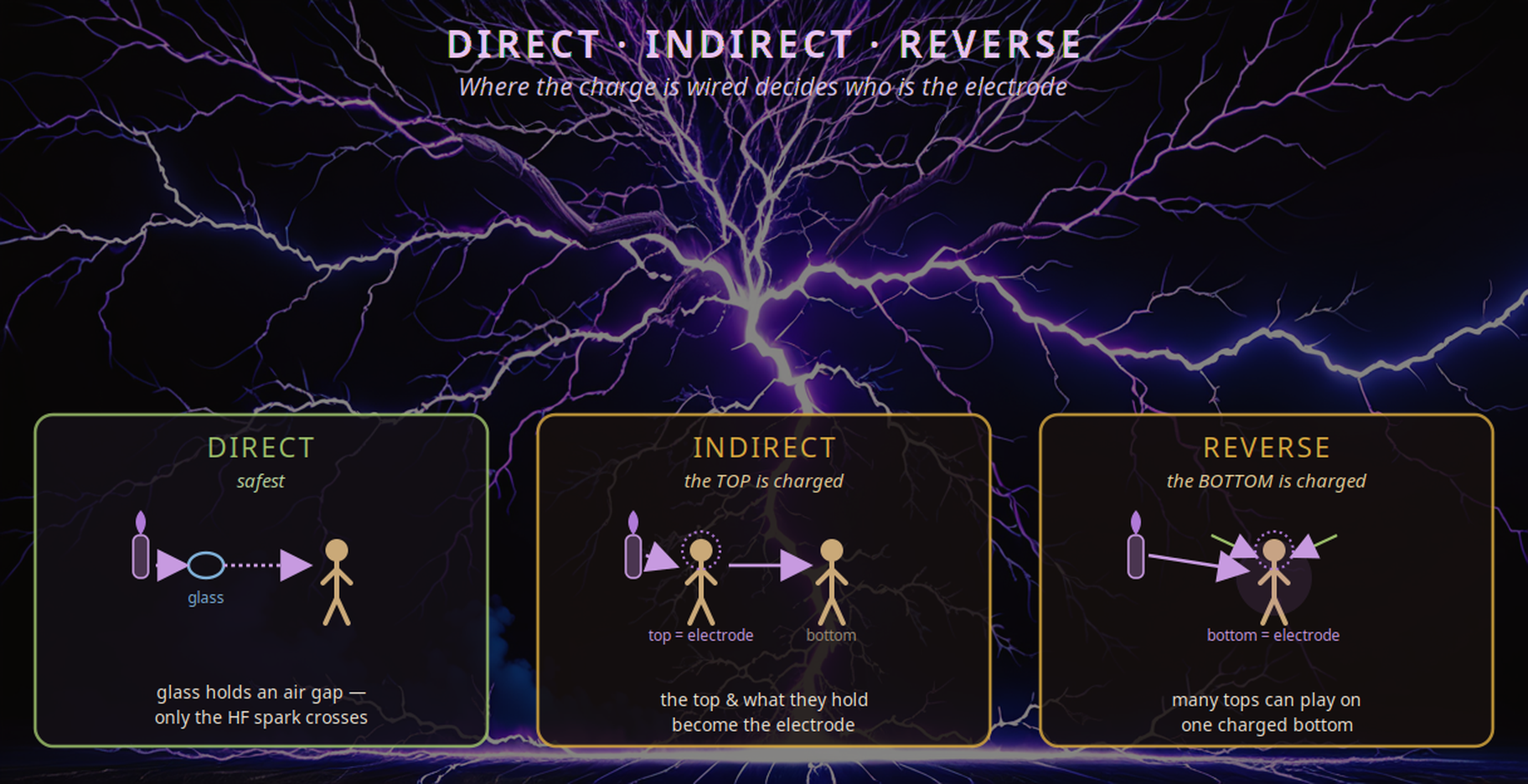
Direct
A glass electrode (mushroom, tongue, a bulb in an adaptor) touches the skin. With quality glass it’s the safest method: if something fails, current can’t jump wand-to-person, because the glass holds an air gap and only the HF discharge crosses.
Indirect
A body-contact probe wires the charge into you, the top — so you, and anything conductive you hold (a spoon, a Mylar flogger), become the electrode. Smaller contact area = more intense (a fingertip far outbites a flat palm).
Reverse
Same as indirect, but the probe wires to the bottom. Now they’re the charged one — which lets multiple tops play on them at once with different implements.
Test the spark gap in the body-contact probe. Over time carbon builds up and can close that gap, letting direct current pass straight through — that gap is the last line of defence between a fault and a person. And test the outlet ground for wiring faults before you plug in. In reverse especially, confirm the probe makes good, continuous skin contact — a poor contact quietly burns.
VII.Electrodes for a 101
Start with the glass set and a body-contact probe. Leave the inside of the body for later.
- The standard glass set that ships with a wand — mushroom, comb, rake, tongue — is the right starting point. Broad heads spread the charge and feel smooth; finer shapes concentrate it and feel sharp.
- A body-contact probe turns the whole body into the electrode and opens up indirect/reverse play — Mylar floggers, a metal spoon, basically anything metal as a “toy.”
- Prefer non-porous glass rated for corona discharge over bare metal, which behaves differently and can heat.
Anything marketed or labelled for internal use is a separate, higher-risk category with its own rules — it belongs in an advanced class, not here. Many electrodes are explicitly non-insertable; using a non-insertable electrode internally, or sharing internal electrodes, raises real infection and STI risk (§ XII).
VIII.Contact, Corona & the Spark
Where the light and the bite come from — and the three levers that set intensity.
The HF, high-voltage output ionises the air and excites the gas in the tube, producing a visible corona and occasional tiny arcs when the electrode is very close to or briefly lifted from the skin. The audible, tactile snap is the discharge crossing a small air gap.
- Broad, continuous contact → diffuse corona, a smoother tingle.
- A focused tip, or briefly breaking contact → short, sharp discharges felt as snaps or bites.
Three levers set how intense a given moment feels: contact area (large heads spread and soften; small tips concentrate and sharpen), electrode shape, and proximity to the skin — on top of the device’s output setting and the session’s duration. And perception is personal: skin thickness, moisture, recent topical products, and individual nerve sensitivity all change the feel, so the sensation your partner reports is the primary guide, not the dial.
Before you read on, picture the softest sensation you could deliver with this tool and the sharpest, and write down the lever you’d reach for first to travel between them. If your instinct was to turn the dial, look at the three levers again — which one would let you sharpen the feel without ever raising the output? Naming that move now, in the calm, is how you keep the dial honest later, in the moment.
IX.Grounding & Current Paths
Safety is about keeping the current’s path predictable.
Electrical play is safe when you know where the current can go and unsafe when you don’t. Unintended conductive paths — through the chest, through an implant, through a stray piece of metal — are exactly the failure you’re guarding against.
- Don’t create improvised conductive links that could route current across the torso.
- Be cautious of conductive surfaces, belts, and furniture that could quietly form a path through the chest.
- Keep stray metal out of the field, and keep the deliberate path (electrode → surface → off) the only path there is.
This is the same instinct as the spark-gap and outlet-ground tests in § VI: make the path you intend the only path that exists.
X.Negotiating & Medical Screening
The hard-no questions come first — before the fun ones.
Because the contraindications are medical and the hazards technical, the consent bar here is high: a partner has to understand the real risks to consent meaningfully. Lead with the disqualifiers, screen health honestly (kept confidential, used only to assess safety), then negotiate the scene. Confirm no alcohol or impairing substances, and always demo the equipment and do a low-level test first.
XI.Core Safety Habits & a Responsible First Scene
The unglamorous habits are the class. Build them before you build a scene.
- Test the outlet is wired correctly before plugging in; prefer GFCI protection.
- Inspect the gear — cracked glass, frayed cords, loose connections all out of service.
- Start at the lowest effective setting and work up only with comfort; the reported sensation leads.
- Power off the wand when you change electrodes, and mind the collar of the wand — it’ll bite you if you get close.
- Don’t overwork one spot with a fine-point electrode — it leaves marks.
- Ventilate the space (ozone), keep flammables and oxygen out, jewellery off, and have a sober person who can stop the scene and a plan to get medical help.
- Stop immediately for unexpected pain, numbness, breathing trouble, or any sign of device malfunction.
Short, low-intensity, highly supervised, and medically screened. Broad non-insertable electrodes, conservative settings, chest and neck left alone, jewellery and flammables excluded, a clear safeword and non-verbal signal, continuous monitoring of breathing/colour/comfort, and a ventilated room. A first scene is a learning experience, not a test.
XII.Gear: Choosing & Caring for a Wand
Provenance, labelling, and the maker’s cleaning instructions — equipment literacy is safety.
| Decision factor | What to look for | Why it matters |
|---|---|---|
| Power type | Solid-state vs. electromechanical | Solid-state = consistent, beginner-friendly; electromechanical = higher output for heavy play |
| Electrode material | Glass (non-porous) vs. metal | Glass cleans easily and is made for corona; metal behaves differently and can heat |
| Labelling | “Non-insertable” vs. “internal” | Signals intended use and sterility expectations |
| Accessories | Body-contact cable, GFCI, spare electrodes | Add safety and flexibility; reputable kits include them |
| Vendor support | Documentation, repair/parts availability | Repairability and clear docs reduce long-term risk |
Cleaning & hygiene
- Follow the maker’s instructions per electrode — don’t assume every attachment is cleaned the same way; vendors document material-specific care.
- Shared surface electrodes: non-porous glass with a compatible disinfectant; when sharing, use single-use barriers or ensure validated disinfection between users.
- Internal/insertable: treat as medical-grade or single-user unless the maker provides validated sterilisation — sharing them unsterilised raises infection and STI risk.
- Never improvise — don’t modify electrodes or use damaged glass; repairs and wiring faults are a documented source of harm.
XIII.Aftercare
Mostly gentle, occasionally medical — and the mind comes too.
- Skin: keep burn cream in the kit — first-degree, sunburn-like marks are common. Cooling and topical care help.
- Watch over the next while for persistent redness, blistering, or numbness, and seek medical care for burns or signs of infection.
- If a clinic visit becomes necessary, document the device and electrode used (model, electrode type, settings) for the clinician; if implants or conditions exist, get clinical clearance and bring device documentation.
- The person, not just the skin: the arcs, ozone, and intensity can land hard — offer quiet time, warmth, and an emotional debrief, and expect a possible drop. (See Aftercare 101.)
Walk through the actual room you would play in — the floor, the furniture, the outlet, what you’d wear — and pause on each thing the lesson has flagged: a conductive surface, a stray length of metal, a poorly grounded outlet, jewellery you forgot you had on. Write down the one item in that space you are least sure about, and decide now how you would test it or remove it. The hazard you can name in advance is the one that never surprises you mid-scene.
XIV.Myths That Get People Hurt
Each of these has put someone in harm’s way. Learn to spot them on sight.
- “Violet wands aren’t edge play.” They are — and treating one as a safe toy is the mistake that hurts the most people.
- “High voltage = high danger to the heart.” Voltage alone doesn’t set cardiac risk — waveform, frequency, current path, and energy do. The wand’s HF, low-energy discharge behaves differently from low-frequency currents that can pace or fibrillate — but faults and bad current paths can still create dangerous exposure, so contraindications stand.
- “If it’s a toy, it can’t hurt you.” Consumer devices vary widely; misuse, damaged wiring, improvised metal contacts, or flammable environments cause burns, fires, ozone exposure, and dangerous current paths.
- “Glass electrodes are sterile and fine to share internally.” Glass is non-porous but not automatically sterile; many electrodes are explicitly non-insertable, and internal use or sharing demands validated sterilisation or single-user practice.
- “Violet wands are the same as TENS/e-stim.” Different modalities, frequencies, sensations, and cardiac/pacemaker profiles — follow device-specific contraindications.
- “If they feel fine, there’s no risk.” Some harms — arrhythmia, implant interference, ozone inhalation, delayed burns, infection — aren’t immediately obvious. Screening and conservative practice still matter.
XV.Common Beginner Mistakes
The errors that actually cause the injuries.
- Metal jewellery or piercings in the play area — jewellery concentrates heat and burns.
- Assuming all electrodes are interchangeable — shape, material, and label (non-insertable vs. internal) change both sensation and risk.
- Improvising contacts or modifying electrodes — homemade metal contacts, damaged glass, and taped repairs create unpredictable current paths and failures.
- Working the chest, neck, or head without clearance — even with HF, proximity to the heart and carotids raises risk and is a common point of confusion. Default away from it.
- Ignoring ventilation and flammables — alcohol, oil-based lubes, oxygen, and ozone build-up are real hazards.
- Skipping device inspection — unchecked cords, plugs, and vendor guidance raise the chance of mains coupling and other faults.
- Sharing internal attachments without validated sterilisation — infection and STI risk.
- Ramping intensity too fast, or not stopping on a signal — rapid escalation and weak stop-signal habits cause injury and break consent.
XVI.Before You Spark
A gut-check. Tap to tick — and notice anything you can’t honestly check off.
If you remember one thing: a violet wand is edge play, not a safe toy. It’s a Tesla coil that throws high-voltage, high-frequency current across the skin — beautiful, but able to burn, ignite, or (with a bad probe and a wiring fault) kill. Screen the hard no’s, test your outlet and spark gap, keep flammables and stray metal away, start low and let the reported sensation lead, stay off the chest by default, and keep burn cream and a sober monitor close. The light show is the easy part; the discipline underneath it is the class.
XVII.Quick Glossary
- Violet wand
- A resonant Tesla-coil device that discharges high-voltage, high-frequency, very-low-energy RF into glass gas-tube electrodes and the skin.
- Corona
- The soft, glowing electric discharge across broad contact — the gentle end of the sensation range.
- Spark / snap
- A short, sharp discharge crossing a small air gap — the sharp end of the range, from a focused tip or briefly broken contact.
- Solid-state vs. electromechanical
- The two wand families; solid-state runs higher-frequency and “stingier,” electromechanical (Tesla) runs deeper and “thuddy.”
- Direct play
- A glass electrode on the skin; the glass air gap makes it the safest method.
- Indirect / reverse play
- A body-contact probe charges the top (indirect) or the bottom (reverse), turning a person and any conductive prop into the electrode.
- Body-contact probe
- The cable/handle that wires the wand’s charge into a person for indirect/reverse play; its spark gap must be tested.
- Spark gap
- The small air gap inside a probe that is the last defence against direct current passing through; carbon build-up can close it.
- Skin effect
- The tendency of high-frequency current to travel along the body’s surface rather than penetrate — why a violet wand’s cardiac profile differs from TENS.
- TENS / e-stim
- A separate, low-frequency electrical modality that drives nerve and muscle through skin pads — different sensations and a different, higher cardiac/pacemaker risk profile.
- GFCI
- A ground-fault circuit interrupter; outlet/power protection that cuts power on a fault — preferred for electrical play.
- Ozone
- The sharp-smelling gas produced by electrical discharge; a reason to ventilate the space.