
Where to strike, where never to, how to build up, how to read your partner, and how to keep your toys clean.
Impact play — spanking, flogging, paddling, caning, and related sensation play — is one of the most popular activities in the kink world and one of the easiest to do badly. The difference between a thrilling scene and a trip to the ER usually comes down to two things: where you strike and how you build up to it. This class covers both.
What you’ll be able to do
By the end of this lesson, you’ll be able to…
- Locate the safer, caution, and no-hit zones on the body map — and explain why the “lower back” is the beginner’s deadliest mistake.
- Rank common implements from thuddy to stingy, and choose a beginner-appropriate starting tool.
- Sequence a scene — warm up, build gradually, aim then commit, check in, cool down — instead of opening at full force.
- Distinguish a partner who is processing intensity from one in distress, and read the skin and stop-now signals.
- Clean porous and non-porous toys correctly, and plan aftercare for drop in both partners.
- Apply foundational striking craft — hand shaping, the flogging Three Tenets, and cane pacing — to deliver sensation deliberately, by skill rather than force.
Almost everyone arrives at impact play already knowing how to swing a hand — which is exactly why it is so easy to do harm. The skill this class teaches is not force; it is placement and pacing. Learn where the body is built to take a blow and where it never can, learn to open quiet and build by degrees, and the rest is craft you can sharpen for years. Get those two wrong and a willing partner ends the night injured.
You already carry the spine of this from Consent & Negotiation and any safety-101 work you’ve done: informed, ongoing, revocable consent and a safeword everyone honors instantly. Here that frame meets a physical practice, and the body map below is the one piece of knowledge to fix in memory before an implement ever leaves the bag.
In this lesson: the groundwork — what happens before a strike, and the body map that governs everything (§ I–II) · your tools — ranking implements and caring for them (§ III–IV) · in the scene — reading your partner, processing intensity, and running it safely (§ V–VII) · the craft of the strike itself (§ VIII) · closing out — aftercare and drop, the pre-scene checklist, and a glossary (§ IX–XI).
I.Before A Single Strike
Safety starts long before any implement comes out. These are non-negotiable, every time, with every partner.
Consent & Negotiation
Agree in advance on what is on the table: which activities, which implements, how intense, where marks are allowed, and whether marks are okay at all (think about work, family, and clothing). Discuss relevant health factors — blood thinners and aspirin, easy bruising, recent injuries, joint or back problems, pregnancy, heart conditions, and any history of fainting. Negotiation is not a mood-killer; it is the thing that lets both people relax into the scene.
Safewords
Use a clear system everyone knows. The classic is Green (good, keep going / more), Yellow (ease off, check in, approaching a limit), and Red (full stop, now). For anyone gagged or non-verbal, agree on a nonverbal signal — a held object dropped from the hand, or three loud taps. Honor a safeword instantly and without negotiation or guilt-tripping.
Sober Play Only
No meaningful alcohol or other intoxicants for either partner. Impairment ruins judgment of aim, force, and a bottom's ability to track their own body and call yellow before something goes wrong.
Have A Plan
Know where a phone and basic first aid are. Have water within reach. Know the bottom's emergency contact and any medical info if you are not already close. A few minutes of preparation buys a lot of safety.
Everyone Has A Job
Impact play is collaborative — there is no purely passive partner. Safety is shared, not something one person manages alone.
The Top Wields
- Read the body, not just the words
- Know the zones cold
- Clean and know your toys
- Practice new implements solo first
- Calibrate force honestly — most Tops underestimate it
- Stay sober
The Bottom Receives
- Know and state your limits
- Disclose health factors
- Use your safeword — using it is responsibility, not failure
- Check your own headspace going in
- Engage honestly in aftercare
Both, Always
- Consent: informed, enthusiastic, ongoing, revocable
- Renegotiate as things change
- Watch for drop afterward
- Keep learning
II.The Body Map
This is the heart of the class. The body is not a uniform target — some areas are padded with muscle and fat and tolerate impact well, while others sit directly over organs, nerves, bone, or the spinal cord and must never be struck. Learn this map before you ever pick up an implement.
Impact Zones — Where To Strike & Where Never To
Most impact play targets the back of the body. The front carries far more vulnerable targets, so beginners should generally stay behind their partner.
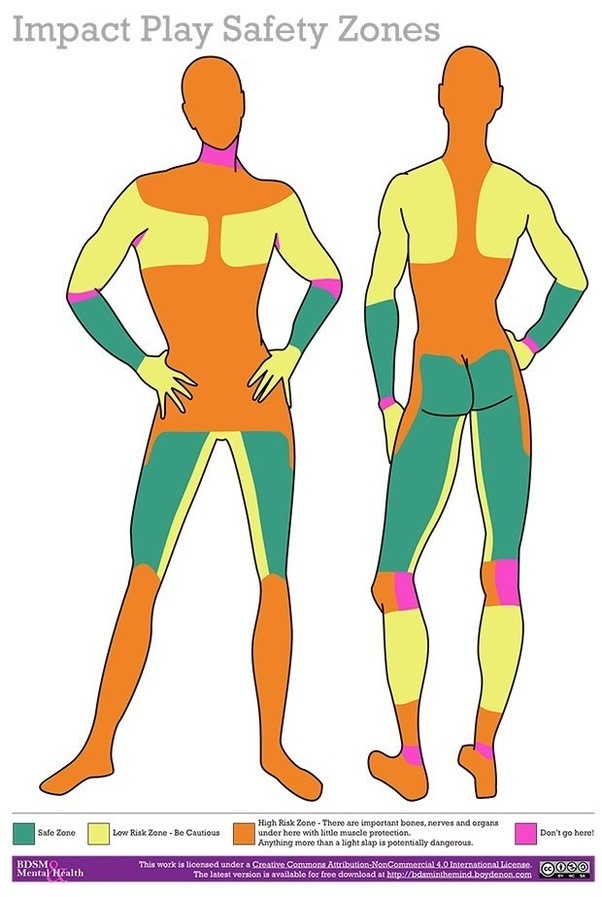
These diagrams are a simplified guide. Bodies vary, and the boundaries between zones are gradual, not hard lines — always err toward the center of a safe zone and away from any edge.
- Buttocks / glutes — the primary target. Most muscle and fat, most forgiving. Stay on the meat; avoid the tailbone (center top) and the lower crease.
- Backs of the thighs — fleshy and tolerant (a lighter low-risk stripe runs down the back), but stop short of the back of the knee.
- Front thighs — the meaty quad takes impact well; keep off the low-risk inner-thigh stripe.
- Forearms — muscle and bone padding over a forgiving surface; a good warm-up target on front or back.
- Shoulders & upper chest (front) — thinner padding over collarbone and joint; moderate sensation only.
- Upper back / shoulder-blade area — to the sides of the spine, never on it. Lighter implements only.
- Wrists (front and back) — little tissue over small bones; keep it light.
- Inner-thigh stripe — close to major blood vessels and very sensitive; light only.
- Back-of-thigh stripe & calves (back) — tolerant but with little muscle over bone in places; build slowly.
- Head & face — concussion, eye and dental injury; important bones with little muscle protection.
- Back of the neck / nape — thin tissue over the cervical spine.
- Mid & lower torso, soft belly — over the liver, spleen, intestines and bladder, with little muscle protection.
- Mid-back, spine-adjacent & lower back / kidneys — the #1 beginner mistake is aiming for the "lower back." Organs and bones under thin muscle.
- Upper arms, hands & hips/groin — bone and nerves close to the surface.
- Front of the knees, shins & lower legs — bone directly under skin.
- Feet & heels — dense with small bones and nerves; anything more than a light slap is potentially dangerous.
- Genitals — intentional genital impact is a specialized, advanced skill, not beginner territory.
- Throat (front) — airway and carotid-artery damage. Potentially fatal.
- Elbows (front and back) — nerves and tendons over unprotected joint.
- Backs of the knees — soft hollow packed with nerves, vessels and tendons.
- Ankles (back) — bone and tendon with no padding.
Without an implement, reach back and put a hand on each spot in turn: glutes, then the flank just below your ribs (the kidneys), then your tailbone, then the backs of your knees. Say out loud “safe” or “never” for each. Feeling the no-hit zones on your own body once makes them automatic when you’re behind a partner and the lights are low.
III.Implements & Their Risks
Implements fall on a spectrum from thuddy (deep, dull, "punch"-like pressure the body reads as thud) to stingy (sharp, surface-level bite). Heavier, broader tools tend thuddy; thin, fast tools sting. Beginners should start thuddy and broad — they are far more forgiving of imperfect aim.
| Implement | Sensation | Skill | Marks & Bruising | Primary Risks | Beginner? |
|---|---|---|---|---|---|
| Open hand | Adjustable; thuddy to light stingyou feel exactly what you deliver | Lowest | Mild redness, light bruising | Mostly risk to your own hand; minimal risk to the bottom | Start here |
| Suede / soft flogger | Thuddy, sensual, "rainfall" | Low | Minimal | Light tips can wrap; otherwise very gentle | Yes · great warm-up |
| Heavy leather flogger | Deep, thuddy, weighty | Moderate | Bruising likely | Wrap-around to ribs / spine if aim drifts; intensity builds fast | With care, later |
| Leather slapper / strap | Mixed thud & sting | Low–moderate | Redness, can bruise | Edges of the leather; aim drift | Beginner-friendly |
| Wide paddle wood / acrylic | Hard, thuddy, broad | Moderate | Deep bruising; can break skin if too hard | Rigid, little feedback; bone bruising on tailbone / hips — easy to overdo | Glutes only, light |
| Riding crop | Sharp, focal sting | Moderate | Welts, redness; tip can split skin | Precise but biting; dangerous near face / eyes if careless | Intermediate |
| Cane rattan | Very stingy, intense, lasting | High | Pronounced welts and lines; can break skin and bruise deep | Wrap, broken skin, lasting marks; easy to cause real damage | No · get instruction |
| Single-tail whip | Extreme sting; can cut | Very high | Welts, cuts, broken skin | Lacerations, wrap, serious eye injury; demands long practice and aim | No · expert only |
| Belt | Heavy, thud-to-sting, unpredictable | Deceptively risky | Bruising, welts | The buckle end is dangerous; hard to aim, edges and wrap | Caution · never the buckle |
Pick one forgiving tool you’d actually start with — your hand, or a suede flogger — and practice on a firm pillow or pool noodle. Mark a “safe zone” the size of a buttock and try to land ten strikes inside it without the tip wrapping over the edge. Notice how much harder aim is than it looks; that gap is exactly why beginners stay thuddy and broad.
IV.Cleaning & Caring For Your Toys
Implements touch skin, sweat, and sometimes blood, and they move between bodies. Cleaning isn't an afterthought — it's how you prevent infection and cross-contamination. The single most useful idea is porosity.
- Silicone, glass, metal, acrylic, sealed surfaces. Sealed, so fluids and bacteria can't soak in.
- Wash with warm, soapy water. Silicone, glass, and metal can be boiled (3–5 minutes) or wiped with a 10% bleach solution (or a dedicated toy cleaner). Don't boil acrylic — disinfect and wipe it instead.
- Anything with electronics (a vibrating toy) is the exception: don't boil or soak it — wipe it with 70% isopropyl alcohol instead, and only fully submersible toys should ever soak in bleach.
- Dry fully before storing. With proper cleaning, these can be shared between partners.
- Leather, suede, wood, rope, fabric, rattan. They absorb fluids, so they can never be made truly sterile.
- Assign porous toys to one partner, or use a barrier (such as a condom over a handle), and never share anything that has touched broken skin.
- Clean by the material-specific methods below, and retire anything cracked or splintered.
| Material | How To Clean | Share? |
|---|---|---|
| Silicone / rubber | Soap & warm water; silicone can be boiled or bleach-wiped (10%) | Yes, if sanitized |
| Glass / metal | Soap & water; boil or bleach-soak for full sanitizing | Yes, if sanitized |
| Acrylic | Wipe with mild disinfectant; do not boil | Yes, if sanitized |
| Leather / suede | Barely-damp cloth right after use; dry fully; condition occasionally — never soak | Keep personal |
| Wood | Wipe with mild soap, dry; seal smooth wood; check for splinters & cracks | Keep personal |
| Rope / fabric | Most are hand- or machine-washable; check for fraying; dry fully | Keep personal |
| Cane / rattan | Wipe with mild disinfectant; inspect for splits before every use; replace when worn | Keep personal |
Clean after every use, dry before storing, and inspect before every use. A cracked paddle or splintered cane can cut, embed material in skin, or land unpredictably — retire damaged toys immediately.
V.Reading Your Partner
In a scene, the body says what words won't — especially once a bottom is deep in sensation. Don't let a safeword be your only signal that something is wrong. The key skill is telling processing (working with intensity) apart from distress (struggling with it).
Before you start, set a baseline: ask how they tend to show pain, pleasure, and distress — some go quiet, some get loud, and neither is automatically a problem. First-timers need slower escalation and more check-ins, and every partner gets re-negotiated every time.
Engaged & Processing
- Arching or leaning into the impact
- Loose limbs, dropping shoulders
- Deep, rhythmic breathing
- Moaning, gasping, vocalizing
- Settled, present eye contact
Check In Or Stop
- Shoulders curling in, body folding away
- Clenched fists, white-knuckled grip
- A hand moving toward the impact zone
- Held, shallow, or panicky breath
- Glazed eyes, eyes rolling back, lost contact (possible subspace)
- Flinching, clenched jaw, tears of fear, or blank dissociation
Check in verbally on any sudden change, before a real jump in intensity, when a loud bottom goes quiet, at the onset of subspace, and any time your gut says something is off — trust that instinct.
Before your next scene, run the baseline conversation in advance: ask your partner how they tend to show pain, pleasure, and distress, and write down the one signal that would make you stop and check in. A loud bottom going suddenly quiet means something different than it does for someone who plays silent — knowing their normal is what lets you catch the change.
VI.Processing The Sensation — For Bottoms
Receiving is an active skill, and most people's capacity grows with practice. The goal isn't to grit your teeth through pain but to work with it.
- Make noise. Gasping, moaning, or crying out moves tension out of the body. Swallowing every sound tends to make sensation pile up.
- Breathe on purpose. Long exhales, or box breathing (in for 4, hold 4, out 4, hold 4), settle the nervous system and dial down intensity.
- Use a mantra. A short phrase — "I can take this" — gives the busy mind a job and keeps it out of panic.
- Ground yourself. Name what you can feel, hear, and see to stay present instead of drifting into overwhelm.
- Picture a safe place. Rehearse a calming image before the scene so you can reach for it quickly mid-scene.
VII.Running The Scene Safely
- Warm up — always. Cold tissue bruises and injures easily. Start with hands or the lightest implement, low intensity, building over several minutes. Warm-up is not optional and not foreplay you can skip.
- Build gradually. Increase force in small steps. The body releases endorphins as it warms, raising tolerance — let that happen naturally rather than opening at full strength.
- Aim, then commit. Place light taps to find your target before adding power. Keep your eyes on the landing zone the entire time. Never strike where you are not looking.
- Check in. Use the color system. A simple "color?" lets the bottom answer green/yellow/red without breaking the scene. Watch body language as much as words.
- Know when to stop. Stop immediately for: numbness or tingling, sharp or "wrong" pain, broken skin you didn't intend, dizziness, nausea, going pale or cold, shaking that reads as distress rather than release, or any red.
- Cool down. Taper off the way you built up. Don't end abruptly at peak intensity.
Reading The Skin
- Even pink or red across the area — the normal, healthy sign of good blood flow to a well-warmed zone.
- Patchy or mottled redness — uneven technique, or one spot taking too much; spread it out or ease off.
- Raised welts — skin-level trauma; back off the intensity, and use a cold pack and arnica afterward.
- Broken skin — stop, give first aid, and call it for the day; reassess your implement and force.
Some bruising is expected for heavier play — know your partner's bruising history and how they feel about visible marks before you begin.
VIII.The Craft of the Strike
Sections I–VII covered where you strike and how you run the scene. This is how you wield it — the small craft that turns force into sensation you deliver on purpose. None of it replaces hands-on instruction; it gives you the vocabulary to practice on a pillow and to recognize good teaching when you find it.
Two Maps, One Body — The Sweet Spot
The body map in Section II is a safety map: where you may and may not land. Laid over it is a pleasure map — most people have a sweet spot, an area that reads as especially good. For many it sits in the lower-center of the glutes; for others a little higher, or out onto the thighs. You find it by exploring lightly and asking, then working around it and onto it.
Spanking — Your Hand Is Many Tools
A bare hand is the most expressive implement you own, because you feel exactly what you deliver. Its shape changes the sensation completely:
- Cupped hand — traps a pocket of air for a deep, resonant thud; the most forgiving shape.
- Flat hand — a bigger, sharper punch across the surface.
- Fingers spread, or fingertips alone — concentrated, bright sting. Use lightly.
A thin glove shifts it again — soft leather adds thud, latex adds sting. Vary the spot, too: a soft caress or a light scratch between spanks resets the skin so the next strike lands fresh.
Position is technique — and psychology. Over-the-knee, bent over a sturdy surface, or standing and holding a rail each change the access, the power you can put behind a swing, and the feeling: a steadying hand on the back reassures; a gripped wrist dominates. Choose the position for the body you want to reach and the headspace you want to create — and feel free to move.
Flogging — The Three Tenets
A long-taught flogging framework names what a good scene needs: Accuracy, Intensity, Connection.
Accuracy
- The fall lands where you intend
- Practice the throw in the air; inch in until the tips just reach, then closer for the meat of the tails
- When you miss — everyone does — name it and soothe the spot; that is what keeps a bottom relaxed and trusting your aim
Intensity
- Open short and soft; ramp up as you both warm
- Vary fast and slow, tips and meat, thud and sting
- Let the body’s response set the level — never the soundtrack
Connection
- Like riding a bike: once the mechanics are automatic, the flogger disappears
- What is left is a shared rhythm and exchange of energy
- This is the why — accuracy and a steady build are what earn it
Caning — Light Hand, Long Pauses
The cane has a fearsome reputation, yet a caning can be feather-light or severe entirely by how it is wielded. Two habits separate a skilled caning from a dangerous one:
- Hold it light; build from the wrist. Grip so the cane almost swivels in your hand — never a death-grip. Start with light taps from the wrist, add the forearm as the bottom warms, and reach full strokes only late. A locked grip and a hard opening stroke are how beginners cause real injury and get a scene safeworded early.
- Wait for the sensation to arrive. A cane stroke is not felt at once — it lands, pauses, then a hot line radiates and builds. Space strokes roughly ten to twenty seconds, ideally on the bottom’s exhale. Rush it and the area goes numb, the bottom stops feeling the strokes, and the tempted top hits harder into numb flesh — exactly how damage happens.
On a firm pillow or pool noodle, practice the flogger throw from a step too far away, inching in until only the tips kiss the target, then a touch closer for the meat — ten throws inside a buttock-sized circle without the tips wrapping over the edge. Then, on your own forearm, feel the difference between a cupped and a flat hand. Craft is just these small distinctions, repeated until they are automatic.
Technique is how you get more sensation from less force: shape the hand, throw for accuracy before power, and on the cane, hold light and let each stroke be felt before the next. Skill, not strength, is what makes impact feel good and stay safe — and none of it replaces a mentor and hands-on practice.
IX.Aftercare & Drop
Intense play floods both partners with adrenaline and endorphins. When that fades — sometimes that night, sometimes a day or two later — people can experience "drop," a low, raw, or tearful state. This affects both the bottom and the top.
Plan aftercare while you negotiate, not after. Common needs: water and a snack to restore blood sugar, warmth (a blanket), gentle touch or quiet space (ask which), reassurance, and a check-in message the next day. There is no single "right" aftercare — ask your partner what they need, and tell them what you need too.
Physical
- Water and a snack to bring blood sugar back up
- A warm blanket; a cool cloth or cold pack on hot spots
- Arnica gel on bruises (popular in the community, though the evidence is mixed — use on intact skin only, never on broken skin or by mouth); lotion for skin comfort
Emotional
- Closeness or quiet — follow their lead
- Affirming words, no pressure to talk
- Presence over problem-solving
Drop can land hours or even a day or two later, so check in over the next one to three days after an intense scene — for both of you.
X.Pre-Scene Checklist
Run through this every time, even once you're experienced.
- Activities, intensity, and marks negotiated
- Health factors disclosed (meds, injuries, conditions)
- Safewords agreed — verbal and nonverbal
- Both partners sober
- Water and first aid within reach
- I know the no-hit zones cold
- Starting with a thuddy, beginner-friendly implement
- Targeting the back of the body, center of safe zones
- Warm-up planned before any real force
- Toys cleaned, dried, and inspected
- Any new implement practiced solo first
- Start and finish intensity discussed (1–10)
- Aftercare discussed and ready
XI.Quick Glossary
Common terms, as the community generally uses them — definitions vary by region, so when in doubt, ask how your local community uses a word.
If you remember one thing: stay on the meat, and build up slow. Target the padded back of the body — glutes and thighs — never the kidneys, spine, joints, or head; start thuddy and broad; warm up before any real force. And the rule above all of it: when in doubt, hit lighter, hit lower, and stop to check in.