
The fundamentals of hot-wax play, building on Sensation Play 101: the burn physics, choosing candles and wax, the drip-height temperature dial and lit-candle technique, body zones and skin sensitivity, setting up a scene, basic removal, burn first aid, and screening. The vat, wax art, and temperature contrast come in Wax Play 201.
Off The Traxx · Skills
Wax Play 101
Hot wax tracking down a warmed back, a single drip placed exactly where you meant it. The candle in your hand, in full — pick a low-melt wax, control the height, and the burn risk collapses.
A drop of melted wax leaves the candle, falls a foot through cool air, and lands on the broad muscle below a shoulder blade as a bloom of heat — sharp for a beat, then warm, then gone. That is the whole appeal in one image: an intense, precise dose of heat you placed on purpose, on a patch of skin you chose. Wax instead of whacks. And nearly all of the control that makes it safe lives in the inches between the flame and the skin.
This is a Skills sensation class, and it builds directly on Sensation Play 101. The four dials you met there — type, intensity, location, anticipation — still apply; here we zoom all the way in on the hot one. Sensation Play 101 introduced wax as one tool, with a single overview section and a short melt-point table. This class is wax, in full — the physics underneath that table, a deeper shelf of candles, the drip-height craft with a lit flame in your hand, the body map for wax specifically, removal, and burn first aid. The thesis it all hangs on: drip height is your temperature dial. Choose a low-melt wax, control the height, and most of the burn risk collapses before you ever light a match.
What this class does not cover is deliberate — it waits for Wax Play 201. The melted-wax vat method in depth, multi-color wax art and patterns, large-area and layered work, temperature contrast with ice and cold metal, deep sensitive-area and genital wax, and combining wax with restraint or sensory deprivation all live there. Here we stay with safe, solid fundamentals and a single lit candle — which is plenty for a real, satisfying scene. This isn’t edge play, but it carries real burn and fire safety, so where this lesson names a danger plainly, it means it.
Sensation play, at bottom, is you turning four dials — type, intensity, location, anticipation. This whole class lives inside one of them: the hot one, turned all the way down to a single candle and the height you hold it at.
What you’ll be able to do
By the end of this lesson, you’ll be able to…
- Explain why wax burns — the gap between a wax’s melt point and the temperature it actually lands at.
- Choose a beginner-safe candle and refuse the dangerous ones on sight at the shelf.
- Control heat with drip height and a self-test, and pace drops so heat doesn’t pool.
- Map where wax reads well on the body and the no-go zones to keep it off.
- Respond to a burn, recognise when it’s medical, and screen out who shouldn’t play today.
In this lesson: what wax play is and why it pulls (§ I) · the burn physics you actually need (§ II) · choosing candles and wax (§ III) · the drip-height dial with a lit candle (§ IV) · body zones and skin sensitivity (§ V) · setting up the scene, including the oil question (§ VI) · basic removal and burn first aid (§ VII–VIII) · screening, your pre-flight checklist, and the glossary (§ IX–XI).
I.What Wax Play Is — And Why It Pulls
Wax instead of whacks: a precise, controllable dose of heat on a small patch of skin.
At its simplest, wax play is dropping hot liquid wax onto skin to deliver a measured amount of heat to one localized spot. It’s another way to bring intense-but-stimulating sensation to the body — cousin to a flogger’s thud, except that heat hands the top far more variables to play with. Done within range, most people read it as vivid and pleasurable rather than painful.
Part of the appeal is how accessible it is. The materials are cheap, sold almost everywhere, and sit in the home as perfectly vanilla candles. You can even learn the feel of it partly on yourself with no partner present. As kink goes it’s relatively forgiving: done right, the worst outcome is a small burn of the kind people pick up at the stove. None of that makes it free of risk — it makes it a craft worth doing carefully.
Think of it as the top’s craft, the body as canvas. The same candle runs from very intense to very mellow, all under your control — though the multi-color artwork and pattern work that canvas suggests is 201 territory, not tonight’s. And it’s never a one-way performance: the receiver feels warmth that builds, the satisfying pull when set wax lifts away, and — most importantly — steers the whole scene with their feedback. You read them drop by drop.
In wax terms that means: warm the skin, start the candle high, and drip a few low-stakes test drops before you commit to a spot (Sensation Play 101 owns the why of warming up and starting light; here you just do it with a candle).
A low-melt candle, the right height, a covered surface, and the upper back is a complete, satisfying scene. You don’t need the vat, the brushes, or the artwork to do wax play well — you need to control one candle, and that’s exactly what this class teaches.
II.Why Wax Burns: The Physics You Actually Need
Melt point is not landing temperature. Understand the gap and you stop guessing.
A wax’s “melt point” is the temperature it turns liquid at. What burns you is something else: the temperature the wax is at when it lands. Those two numbers can be far apart, and the gap is set far more by delivery — how the drop falls, and from what height — than by the number printed on the package. This is why two candles with similar melt points can feel wildly different, and why height, not chemistry, is the dial you actually hold.
Some waxes start the race hotter, though. Hardeners and additives — stearin and stearic acid, “dripless” formulations, vybar — raise the temperature at which the wax will flow at all. To drip, it has to be hotter; so it lands hotter. The label says “dripless” or “long-burning” and your skin hears “scald.”
Color matters too, in ordinary household candles. The dye that darkens a candle tends to raise its thermal conductivity — how fast heat crosses into the skin — rather than its melt point. More dye, darker color, faster heat transfer, hotter feel. (Candles made specifically for wax play are formulated so their dark colors don’t do this. The deeper physics of exactly how much color matters is out of scope; with a candle off the grocery shelf, treat dark as hotter and you’ll be right often enough to stay safe.)
Then there’s thermal mass, which is why waiting matters. A thin drip sheds its heat almost at once; a pooled puddle holds it and keeps delivering. Most of the heat actually crosses into the skin as the wax solidifies — so a drop keeps warming for a beat after it lands, and a thick patch goes on warming longer still. That lag is exactly why you give each drop time before the next.
From all of that fall the two ways wax burns, and you watch for both:
- The quick burn — wax applied too hot in a single drop. Wrong candle, too low a hold, a pooled drop you didn’t mean to throw. Obvious in the moment.
- The cumulative burn — warm layers building up on one spot, trapping heat, cooking the skin over time. No single drop felt like too much; the total did. This is the sneaky one, and it’s why you space drops and pace them.
Wax burns two ways: too hot, too fast (a single scalding drop) and too warm, too long (layers piling up and trapping heat). A warm, pleasant sensation and a real scald can be only a few degrees and a few inches of height apart — which is precisely why height and pacing are the whole game.
You don’t need to measure anything for lit-candle 101. Height plus a self-test gives you all the control this class asks for. Precise, thermometer-verified heat belongs to the melted-wax vat method — and that’s a Wax Play 201 tool.
III.Choosing Your Candles & Wax
Most of your safety is decided at the store shelf, before anything is lit.
Reach for the lowest melt points: paraffin and soy. Soy melts coolest of all — oily, soft, giving when you press it — and is the gentlest landing. Plain paraffin runs a touch hotter and more intense; it’s hard and waxy, and a fingernail nicks it. Better than either, when you can find them, are candles made specifically for wax play: low-melt formulations with safe dyes. And the softest possible entry is a massage candle, whose wax melts into warm oil — low-intensity, forgiving, a fine first night.
Just as important is what you leave on the shelf. Refuse beeswax and gel (higher melt temperatures); metallic and glitter candles (metal-powder dyes overheat and can burn where they land); tapers and thin candles (stearin and vybar hardeners raise the melt temperature, so they land hot); “dripless” and decorative candles; and anything plastic-coated, shrink-wrapped, or birthday-style — molten plastic on skin is its own injury.
• Beeswax & gel — higher melt temps, they land hot.
• Metallic / glitter — metal-powder dye overheats and burns.
• Tapers & thin candles — hardeners raise the melt temp; wax drips hot off the flame.
• “Dripless” / hardened — must run hotter to flow at all.
• Plastic-coated, shrink-wrapped, birthday — molten plastic on skin.
• Religious / prayer glass candles — never drip from the lit glass (see below).
That last one earns its own warning. A lit religious or prayer candle in glass concentrates heat at the wick, and the glass can crack or shatter mid-scene — the last thing you want near bare skin and an open flame. Never drip from the lit glass. The only safe way to use one is to melt it down in a crockpot, and that melted method is 201 territory anyway.
Two more shelf checks. Scent and allergy: some people react to fragranced candles and oils, so test for scent sensitivity first — the same patch-test habit Sensation Play 101 teaches for any product. And form factor in one line: a container or votive lets wax pool and run across a cooler surface before it drops, so it lands cooler; a taper drips hot straight off the flame — one more reason beginners skip tapers.
Whatever you buy, the habit underneath it all: always test on yourself first. Every unknown candle goes on your own inner forearm or the back of your hand — never the palm, which is too insensitive to judge — before each scene, dripped from the height you mean to use. Variables remain even after a clean self-test, but skipping it is how an atypical candle catches you out.
| Wax / candle | Typical melt point | Beginner-safe? | Notes |
|---|---|---|---|
| Soy (incl. massage candles) | ~46–57°C / 115–135°F | Yes | Lowest melt point, oily and giving. Massage candles are the softest entry — low intensity. |
| Purpose-made play candle | Low, by design | Yes | Best of all: low-melt formulation and safe dyes, so even dark colors don’t land hotter. |
| Paraffin (plain, unscented, undyed) | ~47–65°C / 117–149°F | With care | Hotter, more intense than soy. Hard and waxy. Always self-test; only undyed and unscented. |
| Beeswax | ~62–65°C / 144–149°F | No | Higher melt temp; usually sold as tapers, which compound the heat. |
| Gel | High | No | Runs too hot for skin. |
| Metallic / glitter | — | No | Metal-powder dye overheats and burns where it lands. |
| Tapers / “dripless” | Raised by hardeners | No | Stearin / vybar push the melt temp up; wax lands dangerously hot. |
IV.The Temperature Dial: Lit-Candle Technique
Height is the main control. A handful of small moves give you the rest.
Here is the craft this class is built on. With a lit candle, drip height is the dial. Start around 30 cm / 12 in above the skin and move closer for hotter, higher for cooler — every bit of extra fall lets the drop shed heat in the air before it lands. Because waxes differ, calibrate your own starting height for each candle rather than trusting a single number across the board.
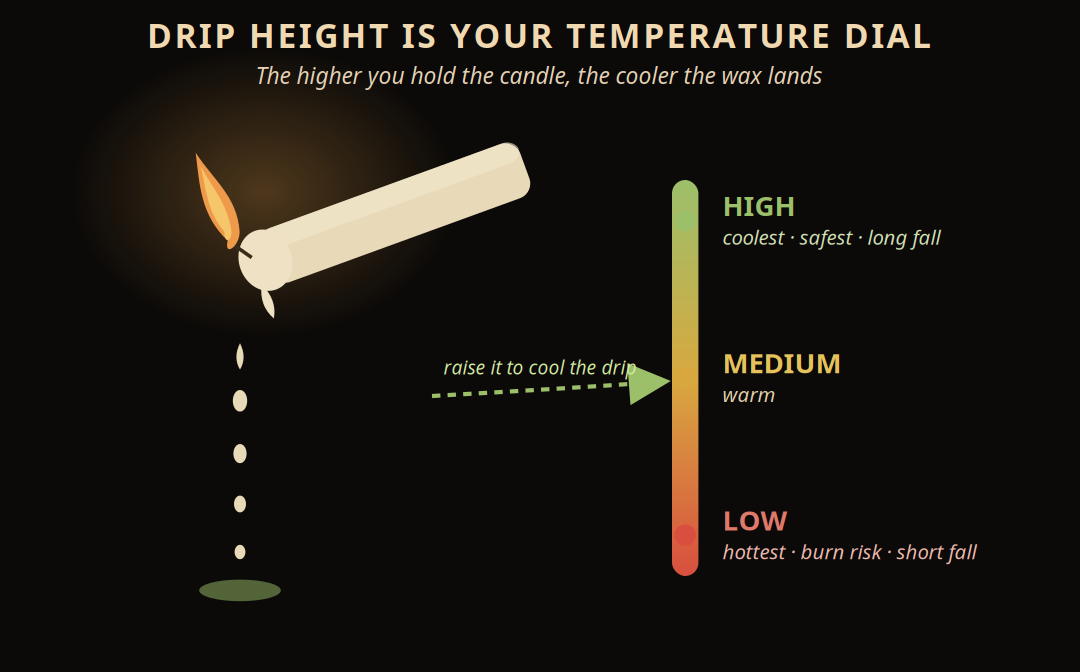
Around that one dial sits a small vocabulary of moves:
- Pooling. Let melted wax collect on top of the candle, then tip it — a fuller, hotter single drop. Use it on purpose, not by accident.
- Flicking / splashing. Throw the wax to scatter it across a wider area; each point lands lighter, the sensation spreads.
- Running wax down the candle. Let the melt travel along the candle surface — across the top, or an inch or more down the side — so it cools more than it would falling through free air. Cutting a small groove guides the run; tilting a drippy candle toward vertical lengthens the cooling path before the drop lets go.
And then you read and adjust in real time. If the spot you’re on suddenly can’t take it — even on someone usually fine with heat — raise the candle, move to less-sensitive skin, or tilt a drip candle more vertical to buy the drop more cooling time. Pace the whole thing: give each drop the few beats it needs to deliver its full heat as it sets before you place the next, and space drops apart so heat doesn’t pool and tip into that cumulative burn. The melted-wax vat, fine thermometer control, and multi-color art all extend this — in 201, not here.
One thing to carry out of this class: High, Test, Low, Slow. Start High — the foot of air is your margin. Test on your own skin first, every candle, every time. Come Lower only as you learn this particular person’s tolerance. And go Slow — space the drops and let each one finish before the next. Height is the dial; the other three keep your hand on it honestly.
Light your candle and drip onto your own inner forearm from a high hold — then lower, drop by drop — and find the exact point where “warm and pleasant” tips into “too hot.” That height is your starting line. Write down which candle it was and the safe distance, so night one is a measurement you already took, not a guess you make over someone’s back.
V.Body Zones & Skin Sensitivity
Skin is not uniform. A drop trivial on a shoulder blade can burn a nipple inches away.
The best canvas for wax is the broad, muscular upper and mid-back — around and below the shoulder blades. It’s forgiving, it’s not sexually loaded, so the receiver can sink into pure sensation, and it’s a wide field for both the drip and the slow pull of removal. Start a first scene here and stay here.
Sensitivity isn’t even, though, and it generally increases as you move lower down the back. Wax that’s delightful between the shoulder blades can be too hot by the small of the back; even within a few inches the reading shifts. Know roughly what sits under the skin — muscle is forgiving, bone and thin skin are not — and recalibrate your height as you move, the same way you would with any of the four dials.
For a beginner, some zones are simply off-limits to a drip:
- Never the face or eyes. No exceptions, no “just the cheek.” Keep wax and its bounce away entirely.
- Nipples, genitals, and mucous membranes. Thin skin, high burn risk — and deep sensitive-area and genital wax is explicitly a Wax Play 201 topic, done with far more care than a first class can teach.
- Broken, numb, or recently sunburned skin. No feedback or no margin; skip it.
And then there’s hair. Wax sets into hair, is miserable to remove, and the smell of singed hair ruins a scene outright. Keep wax out of it: tie back and drape the receiver’s head hair near the work area, and for body hair either cover it, avoid it, or read the oil tradeoff in setup. The fuller hairy-skin methods stay light here — for a 101 scene, the simplest answer is to choose a smooth patch.
This is the wax-specific view of the body. For the general map — the feather, the wheel, the cold columns — go back to Sensation Play 101’s body map; this table doesn’t reproduce it.
Bodies and days vary — old injuries, varicose veins, skin conditions, and the dominant-handed side (which often reads more) all shift what a given drop means. The map tells you where to be careful; it doesn’t replace watching the person in front of you and adjusting to them.
| Area | Great for (wax) | Care / avoid |
|---|---|---|
| Back & shoulders | Broad canvas — the ideal place for the drip and the pull of removal | Sensitivity rises toward the lower back — raise the candle as you move down. |
| Thighs & butt | Forgiving, muscular — reads heat well | Inner thigh is far more sensitive than outer — ease in. |
| Chest & belly | Responsive — usable with care | No wax on nipples for beginners; the belly startles easily. |
| Face & eyes | — | Never — off-limits to wax and its bounce, full stop. |
| Genitals & mucous membranes | — | Not in 101 — thin skin, high burn risk; deep work is a 201 topic. |
| Hair, numb, or broken skin | — | Keep wax off — sets into hair, no feedback on numb skin, infection risk on broken. |
VI.Setting Up the Scene
You are playing with fire on a person. The setup is the safety.
Cover the area first. A cheap plastic shower curtain or tablecloth, a thrift-store sheet, a painter’s drop cloth, a tarp — anything that catches the wax. Drips bounce, bits get trodden in, and ground-in wax is a genuine problem to clean. Lay it down before anything is lit.
Then prep the body and the room. Tie back and drape the receiver’s head hair near the work area; a blindfold is optional and doubles as eye protection from wax bounce. Clear the flammables — oils, lube, alcohol, loose bedding, rope — well away from the flame. Put the candle on a stable, level, non-flammable surface where it can’t be bumped or tipped.
Keep the means to put out fire within reach. The most important one is a damp cloth right at hand — your immediate extinguisher, faster than anything bigger. Add water, and know where a fire extinguisher is, no farther than the next room.
Damp cloth on hand, fire extinguisher within a room, flammables cleared, candle stable and level. Never drip over anything that can catch — bedding, rope, hair. Never leave a lit candle unattended, and never leave your partner alone mid-scene, not even for a moment. And if a burn happens, out first, then water — put the flame out first: blow or snuff the candle and confirm there is no flame and no glowing wick before either of you turns to the skin or heads for the sink. Set the candle down only once it is fully out — never as an alternative to extinguishing it, and never leave a lit candle behind.
Oil, or no oil — the one real choice
This is the single genuine controversy in wax play, and it’s a real tradeoff, not a best practice. With no oil, the wax grips skin and hair: removal is more intense — the satisfying pull as a set sheet lifts — and the burns it makes are smaller but deeper. With an oil massage first, removal is easier and the heat spreads wider and shallower (less intense at any one point), so the burns are larger but shallower. Massage-then-blot-dry sits in the middle. Use a mineral or massage oil, never cooking oil, and plan for a thorough shower afterward if you oil — everything the back touches goes oily. Choose based on the scene you want, not on which is “correct.”
What to negotiate — the wax-specific part
The general consent, negotiation, safeword, and non-verbal-signal material is owned by Foundations and Sensation Play 101 — this builds on it rather than repeating it. Surface only the wax-specific points: consent to cover or restrain hair, agreement on where drips may land, and disclosure of burn history, skin conditions, and anything that affects heat sensation (the screening section picks that up). And keep the one-line reminder: a safeword plus a non-verbal signal are set before you light anything.
During the scene, run the stoplight: green is go, yellow is wait before more, red is stop now. Check in constantly — the receiver’s input drives the pace, drop by drop.
Warm wax followed by a trailing ice cube is a real thrill — and it’s a Wax Play 201 topic. Temperature contrast with ice and cold metal has its own technique and its own risks. Finish clean 101 scenes first; the contrast will keep.
VII.Basic Wax Removal
Check the skin first, let it set, lift it off, soak up the rest. Never pick a burn.
Before any scraping, look the skin over — blisters, broken skin, angry redness. Leave wax undisturbed over any of those; you scrape only the clearly unburned areas. A flat, dull edge won’t cut intact skin, but it can shear the roof off a fresh blister — deroofing — which you must never do; that protective skin has to stay on. Wax that has set over a burn is left alone in the acute phase: run cool (not ice-cold) running water over it and leave the wax in place, then ease it off gently only once the skin has fully cooled and is intact (the burn-first-aid section below, § VIII, carries the full rule) — never with oil, grease, or petroleum jelly (an occlusive that traps heat in a fresh burn), and never by tugging.
On the unburned skin, let the wax cool and set first, then scrape it off with a dull edge held flat to the skin — a dull or butter knife, a comb, a spatula, your fingers, even a flogger. A knife held flat won’t cut; cutting takes an angled blade with pressure, which you’re not doing. Drop the chips straight into a bin as you go.
Dust on baby powder to soak up oil and loosen whatever’s left, then rinse it off in a warm shower. On oiled or hairy skin the sheet crumbles rather than lifting in one piece — go gently with a fine comb or a dull edge, and cut any entrapped hairs free rather than yanking them.
Two hard rules: never pick at or peel a burn, and never yank wax off hair. Both turn a small problem into a wound. If wax has set into hair, free it with care or trim it; don’t rip.
For wax-specific aftercare, look the skin over together for any burn or redness you missed in the moment, put a little fragrance-free moisturizer on heat-tendered skin, and ask the receiver to report any blister or lingering mark tomorrow. The emotional landing — the comedown, the next-day check-in — is owned by Aftercare 101 and Sensation Play 101’s aftercare section; lean on those rather than re-teaching them here.
The slow lift of set wax off warm, sensitized skin is itself a sensation — the pull, that satisfying peel. Let it be part of the scene, then follow with the aftercare you cross-referenced. Don’t rush the landing.
VIII.Burn First Aid
Decide it calmly now so you can act fast later. Out first, then water — never ice. Stopping early is never the mistake.
Know these before you light anything — they sit near the end of the class on purpose, because they’re the part you must not skim.
A burn is the moment your open-flame discipline collapses, so the very first move is to make the flame safe. Out first, then water: put the flame out — blow or snuff the candle and confirm there is no flame and no glowing wick before you attend to the skin or head for the sink. Set the candle down only after it is fully out, never as an alternative to extinguishing it, and never leave a lit candle behind. Only once it’s out do you start cooling the burn.
Cool the area under cool (not ice-cold) running water for 10–20 minutes, and remove jewelry near it. Don’t use ice directly, don’t pop blisters, and don’t put butter or oil on it. Cover loosely with clean, non-stick material.
If wax has hardened over the burn, do not peel or scrape it off — pulling it can strip blistered or burned skin and deepen the injury (this is the same never-pick-or-peel-a-burn rule from removal, § VII). Run the cooling water over the wax and leave any adhered wax in place; remove it only gently, once the skin has fully cooled and is intact, and if skin lifts with it, stop and seek care.
First degree: red, dry, painful, no blisters — like a mild sunburn. You usually manage it at home. Second degree: blistered, wet or shiny, more severe pain — it needs more care, especially if it’s large or in a sensitive spot. When in doubt, treat it as the more serious one.
Get it looked at for: a blister bigger than a small coin; any burn on the face, genitals, hands, or joints; skin that looks white, charred, or leathery (possible third degree); or anything you’re unsure about.
Pain is an unreliable gauge. A deep, full-thickness burn can hurt less than a shallow one, because the heat destroys the nerve endings. Judge a burn by how it looks — size, blistering, white or charred or leathery skin — not by how much it hurt. When the pain reads oddly low for wax that landed hot, treat it as the more serious burn and get it checked. (The no-oil pathway makes burns smaller but deeper, which is exactly when this trap bites.)
An allergic or skin reaction and the thresholds for calling emergency services are the same as any sensation scene — see Sensation Play 101 (When Something Goes Wrong). The short version: stop, wash the area, and treat spreading hives, facial or throat swelling, trouble breathing, a deep or large burn, or fainting that doesn’t resolve as an emergency. Toughing it out is not a virtue.
One note in passing: a cold injury (an ice burn) rewarms gently — warm, not hot, water, and don’t rub. But cold tools and the hot/cold contrast that produce ice burns are a Wax Play 201 topic; here it’s only the safety line.
IX.Screening: Who Shouldn’t Be Under the Candle Today
Reduced heat sensation removes your warning system. Know the flags before you light up.
The core danger to screen for is reduced heat sensation — if the receiver can’t feel a burn building, you’ve lost the body’s own warning. The flags: neuropathy or nerve damage and diabetes; numbing agents and topical anesthetics; and intoxication, which blunts both sensation and judgement. Both of you stay sober enough to feel temperature and to read each other.
- Pregnancy — screen and err conservative; defer to medical advice.
- Skin conditions — eczema, psoriasis, recent sunburn, broken or irritated skin, fresh tattoos: skip those areas.
- Allergy and fragrance sensitivity — carried over from candle selection; confirm before the scene, and patch-test if you’re unsure.
None of this is a checklist you spring on someone at the door. It’s the wax-specific half of negotiation — a kind disclosure conversation you have in advance, the partner to the burn-history and skin-condition point from setup.
When feedback is compromised — numbness, intoxication, nerve issues — you’ve lost the signal that keeps wax safe. The right call then isn’t to play more carefully. It’s to not play with wax that day.
X.Pre-Flight Checklist
Run it every time. Tap to check off.
XI.Glossary
- Wax play
- Dropping hot liquid wax on skin to deliver a precise, controllable dose of heat to a localized area — “wax instead of whacks.”
- Melt point vs. landing temperature
- Melt point is where wax turns liquid; landing temperature is how hot it actually is when it hits skin. The second is what burns, and it’s set mostly by delivery and height.
- Quick burn
- A burn from wax applied too hot in a single drop.
- Cumulative burn
- A burn that develops as warm layers build up on one spot, trap heat, and cook the skin over time — the sneaky one.
- Drip height
- The vertical distance from candle to skin; the main temperature dial for lit-candle play. Closer is hotter, starting around 30 cm / 12 in.
- Pooling
- Letting melted wax collect on top of the candle to produce a fuller, hotter single drop.
- Flicking / splashing
- Throwing wax to scatter it across a wider area, lighter at any one point.
- Running wax down the candle
- Letting melt travel along the candle surface (top, or an inch or more down the side) so it cools more than it would in free air; a cut groove guides it.
- Thermal conductivity
- How fast heat crosses into skin. Dye in dark household candles raises conductivity, not the melt point — which is why darker can read hotter.
- Purpose-made play candle
- A candle formulated for wax play: low melt point and safe dyes, so even dark colors don’t land hotter.
- Massage candle
- A candle whose wax melts into warm massage oil — the softest, lowest-intensity entry point.
- Stearin / stearic acid
- A hardener mixed into cheap, “dripless,” and decorative candles; it raises the melt temperature, so the wax lands hotter.
- Stoplight
- The constant check-in system: green = go, yellow = wait before more, red = stop now.
- The pull
- The satisfying peel sensation when a set wax sheet lifts off dry, well-adhered skin — lost if the skin is wet, sweaty, or oiled.
- First- vs. second-degree burn
- First degree is red, dry, and blister-free (like sunburn); second degree blisters and weeps. The first is usually managed at home; the second needs more care.
- Deroofing
- Shearing the intact roof off a blister — e.g. by scraping wax over a fresh burn. The roof is protective skin; it must stay on, so you never scrape over a blister and you leave wax adhered to a burn in place until the skin has cooled and is intact.
- Vat method, temperature contrast, wax art
- The melted-wax bath, hot/cold contrast with ice and cold metal, and multi-color layered patterns — see Wax Play 201.
For the general sensation vocabulary — sensation play, temperature play, edge play, patch test, aftercare — see the Sensation Play 101 glossary rather than these pages.